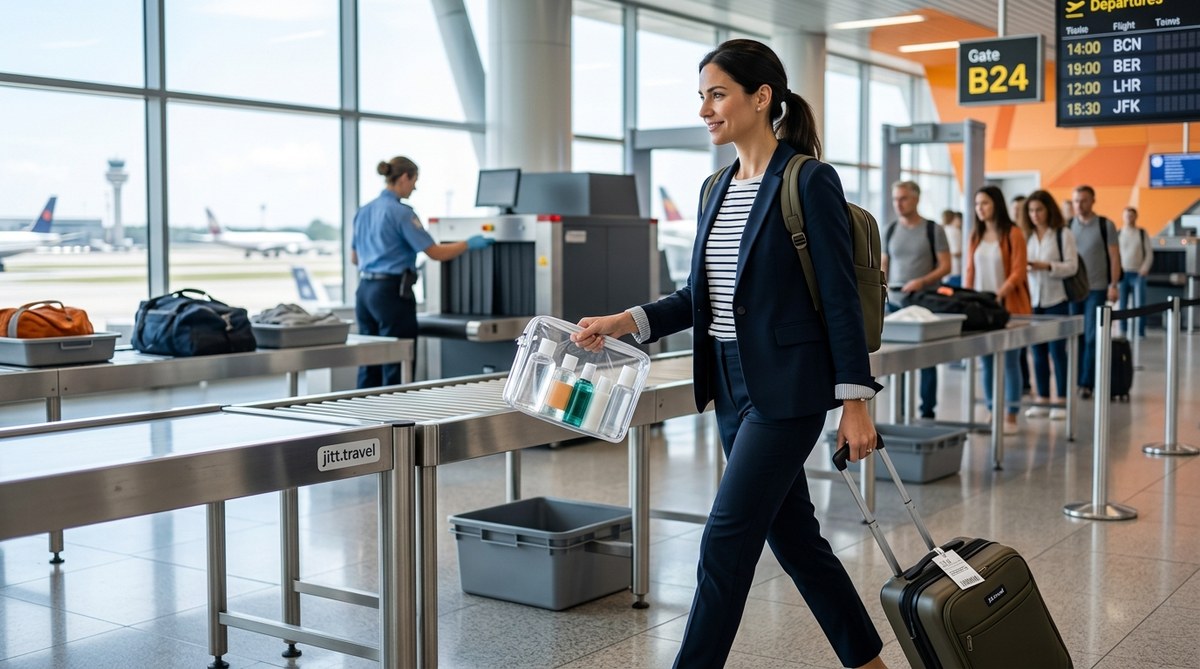
You stand in line, shoes off, belt unbuckled, laptop out of its sleeve. You watch the same scene play out every time. A family of four fumbles with their bags. A business traveler in a hurry realizes their water bottle is still full. The person behind you sighs loud enough for everyone to hear. Airport security does not have to feel this way. The difference between a 10 minute screening and a 40 minute nightmare often comes down to one thing you forgot to bring. Or more accurately, one thing you forgot to leave behind.
The single most effective way to cut your time at airport security is to pack your carry on so that every item you need to remove is in one easy to access outer pocket. That forgotten item is a small, clear, empty pouch that you fill with your laptop, tablet, liquids, and jacket before you even join the line. It saves you from repacking chaos and keeps you moving.
Why most travelers lose time at the checkpoint
The Transportation Security Administration screens nearly 2.5 million passengers every single day. That number keeps climbing. In 2026, major US airports like Atlanta, Chicago O’Hare, and Los Angeles International are busier than ever. The bottleneck is rarely the X ray machine. It is almost always the person in front of you who has to dig through a packed bag to find their iPad, or the traveler who forgot to take out their 3 ounce sunscreen.
When you watch people move through the line, a clear pattern emerges. Those who spend less than 30 seconds at the belt have one thing in common. They prepared for the moment before they arrived. The rest of us waste time hunting, fumbling, and apologizing.
The one item that changes everything
Here is the forgotten item that will save you hours over the course of a year. It is a clear, reusable, quart size zip pouch. Not for your liquids. For your electronics.
Most travelers already know about the 3-1-1 rule for liquids. But they still shove their phone, laptop, tablet, and headphones into different compartments of their bag. When they reach the conveyor belt, they have to pull each item out separately. They set things down. They pick things up. They rearrange. It takes forever.
Instead, put your laptop, tablet, e reader, phone, and a small charging cable all inside that one clear pouch. When you get to the front of the line, you pull out a single bag. Everything goes into one bin. You do not have to open your main carry on at all. The person behind you will not hate you.
A numbered process for a stress free screening
Follow these steps the next time you travel.
-
Before you leave home, set up your clear pouch. Put your laptop, tablet, phone, and any cords inside. Zip it closed. Place it in the outermost pocket of your carry on.
-
As you approach the checkpoint, take off your jacket, belt, and shoes. Put them inside your carry on if there is room. If not, hold them in your hands.
-
Remove your clear electronics pouch from your bag. Place it in one bin. Place your shoes and jacket in a second bin. Place your carry on on the belt.
-
Walk through the metal detector or body scanner. Grab your bins on the other side. Repack your clear pouch into your bag. Done.
This process works because it eliminates the back and forth. You never have to open your main bag. You never have to search for a loose cable. You never hold up the line.
What you should and should not do at security
Here is a quick reference table for common mistakes and the right way to handle them.
| Mistake | Why it hurts | Better approach |
|---|---|---|
| Packing liquids in a checked bag that you then carry on at the last minute | You get flagged and pulled aside for a bag check | Keep your liquids in one quart bag, at the top of your carry on |
| Wearing complicated shoes like boots with laces | You spend a full minute taking them off and putting them back on | Wear slip on shoes or loafers on travel days |
| Leaving snacks in your bag | The X ray operator sees a dense mass and asks to inspect | Put all food in a separate bin or remove it before the belt |
| Forgetting to empty your water bottle | You get stopped, have to dump it, then wait for the bottle to go through again | Empty all bottles before you enter the security line |
| Wearing a metal belt or watch | You set off the alarm and get a pat down | Remove metal items before you step through the detector |
The TSA PreCheck shortcut that most people ignore
TSA PreCheck is great. It lets you keep your shoes on, your laptop in your bag, and your liquids packed. But here is the catch. Even with PreCheck, you can still get stuck behind someone who does not know how to move through the line. The real trick is to use the PreCheck lane during off peak hours.
If you fly out of a major hub like Dallas Fort Worth or Denver, the PreCheck line can be just as long as the regular line between 6 AM and 9 AM. Aim for flights that depart before 6 AM or after 10 AM. You will walk straight through.
“The biggest time saver at airport security is not a faster lane. It is knowing exactly where every item in your bag is. If you have to think about where you put your phone, you have already lost time.” — Former TSA officer, 12 years of service
The packing mistake that costs you 15 minutes
Many travelers stuff their electronics into a personal item like a backpack or a tote bag. Then they put that personal item under the seat in front of them during the flight. When security comes, they have to pull everything out of that cramped bag. It is a disaster.
A better system is to use a dedicated tech pouch that lives inside your carry on but comes out as one unit. You can find these pouches at any travel store or online for under 15 dollars. The clear ones are best because the TSA agent can see what is inside without opening it.
A bulleted list of scanning essentials
When you place your items on the conveyor belt, keep these rules in mind.
- Place your clear electronics pouch in its own bin. Do not stack anything on top of it.
- Put your jacket and shoes in a separate bin. Do not mix them with your bag.
- Keep your boarding pass and ID in your hand or in a pocket that you can reach without digging.
- Do not put your phone in the bin if it is inside your pouch. The pouch is fine.
- If you carry a camera, put it in the same clear pouch as your laptop. It will not get scratched.
The forgotten item that saves you at the ID check
Here is another item most people forget. A simple business card holder or a small card sleeve that holds your ID and boarding pass together. When you reach the document checker, you want to hand over your ID in less than two seconds. Fumbling through your wallet while people wait behind you creates a ripple effect. The line slows down for everyone.
Keep your ID and boarding pass in the same pocket of your jacket or pants. Do not put them in your carry on. Do not put them in your wallet if your wallet is buried in your bag. Keep them on your body.
How to handle the liquids rule without stress
The 3-1-1 rule means each liquid container must be 3.4 ounces or less, all containers must fit inside one quart size bag, and each passenger gets one bag. That rule is not changing in 2026. But you can make it easier.
Buy a set of travel size containers and fill them with your shampoo, conditioner, and lotion. Put them in a clear quart bag. Place that bag at the very top of your carry on. When you get to security, pull out the bag and put it in a bin. Do not leave it inside your carry on. The X ray operator will see the dense shapes and ask you to remove them anyway.
What to do if you get pulled aside
It happens. Maybe your bag looks suspicious on the X ray. Maybe you set off the metal detector. Do not panic. Do not argue. The fastest way through a secondary screening is to cooperate.
If an officer asks to search your bag, tell them exactly what is inside. “I have a laptop, a tablet, a charging cable, and a toiletry bag.” If you packed your clear pouch correctly, you can point to it and say “The laptop and tablet are in that pouch.” The search will take 30 seconds instead of three minutes.
The real cost of not preparing
Let us do the math. If you fly six times per year, and each time you spend an extra 10 minutes at security because you are not prepared, you lose one full hour per year. Over a decade, that is ten hours. Ten hours of standing in line, waiting, watching other people move past you. That is a whole workday.
Now add the stress. The feeling of being rushed. The anxiety that you might miss your flight. The dirty looks from other passengers. It is not worth it.
A table of time saving techniques by traveler type
| Traveler type | Best technique | Time saved per trip |
|---|---|---|
| Frequent business traveler | TSA PreCheck plus clear electronics pouch | 15 to 20 minutes |
| Family with kids | Prepack each person’s electronics in a labeled pouch | 10 to 15 minutes |
| Weekend leisure traveler | Wear slip on shoes, empty all bottles before arriving | 5 to 10 minutes |
| International traveler | Keep passport and visa in a dedicated card sleeve | 5 minutes |
| Student or budget traveler | Use a clear backpack to avoid bag checks | 10 minutes |
The morning of your flight checklist
Before you leave for the airport, run through this list. It takes 60 seconds.
- [ ] Clear electronics pouch is packed with laptop, tablet, phone, and cables.
- [ ] Liquids are in a quart size bag, at the top of your carry on.
- [ ] Your jacket is easy to take off. No complicated zippers.
- [ ] Your shoes slip on and off. No laces.
- [ ] Your ID and boarding pass are in your pocket or a card sleeve.
- [ ] All water bottles are empty.
- [ ] Snacks are in a separate bag, not buried in your main bag.
If you check every item, you will move through security faster than 90 percent of the people around you.
Why this works at every airport
Whether you are flying out of a small regional airport like Bozeman Yellowstone International or a massive hub like Hartsfield Jackson in Atlanta, the same rules apply. The TSA process is standardized. The bins are the same size. The X ray machines work the same way. The officers follow the same procedures.
Your preparation is the variable. You control it.
Putting it all together for your next trip
The next time you book a flight, think about your security strategy before you pack. If you are planning a trip to a city you have never visited, like 15 hidden neighborhoods in Paris that most tourists never discover, you will want to save your energy for the adventure ahead. Not waste it in a security line.
The same principle applies to any destination. A first timer’s guide to navigating Rome like a local will tell you to skip the tourist traps and walk the side streets. That advice only matters if you actually make your flight. Security is the gate you have to pass through first.
The one thing you will never forget again
From now on, your clear electronics pouch is non negotiable. It goes in your bag before your clothes. It comes out at security before your shoes. It is the single item that ties every airport security tip together.
You will save time. You will save stress. And you will wonder why you did not do this years ago.
Start your next trip the right way
The next time you stand in that security line, you will be the person everyone else watches. The one who glides through. The one who pulls out a single pouch, places it in a bin, and walks through without a second thought. That can be you. It starts with one clear pouch and a little bit of planning.
Pack it tonight. Your future self will thank you.