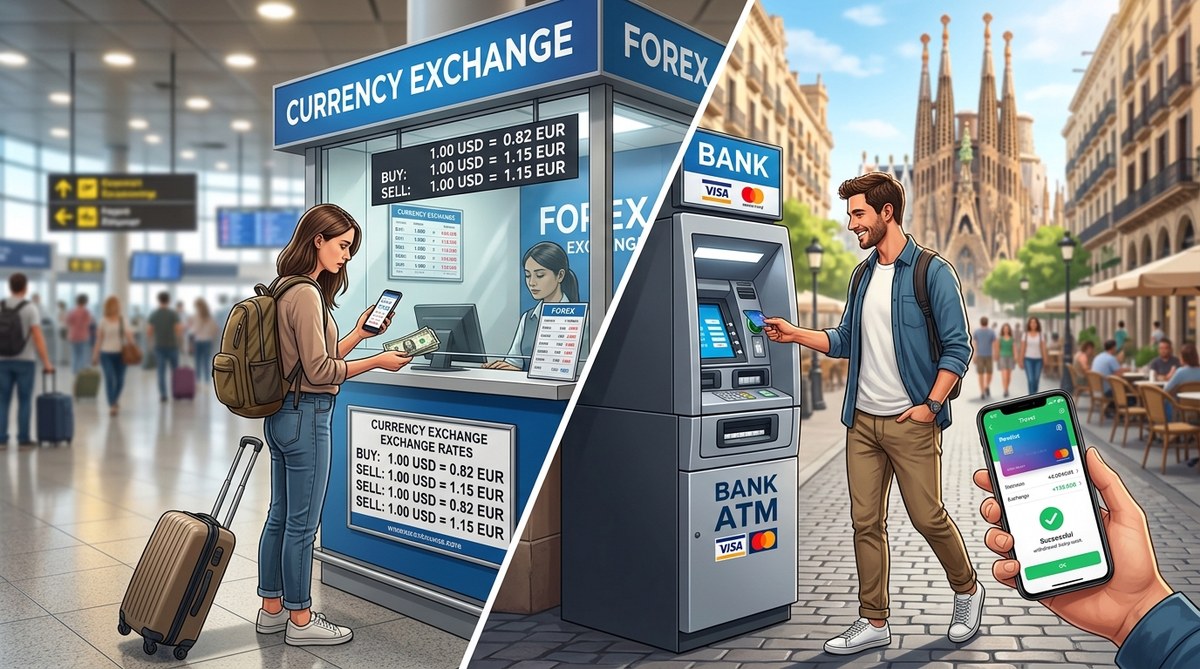
You walk past those glowing currency exchange kiosks at the airport every time you fly internationally. The rates are posted in bright digital numbers. The clerk smiles. It feels convenient. But that convenience comes with a price tag that is almost always awful for your wallet. Exchanging money at airport counters is one of the most expensive financial decisions you can make while traveling. The fees, the poor rates, and the hidden charges eat into your travel budget before you even leave the terminal. And the worst part? You have much better options that take almost no extra effort.
Airport currency exchange counters charge fees of 8-15% through bad rates and hidden commissions. Instead, use a fee-free debit card at a local ATM, order currency from your home bank before departure, or use a digital travel card like Wise or Revolut. These methods save you serious money and give you better rates. Avoid the airport kiosk entirely and you will keep more cash for the experiences that actually matter.
The Real Cost of Exchanging Money at Airport Kiosks
Airport currency exchange counters look like they offer a simple service. You hand over US dollars. They hand back euros, yen, or pounds. But the math rarely works in your favor.
Most airport exchange booths advertise with phrases like “zero commission” or “no fee.” Do not be fooled. They make their money on the exchange rate itself. The rate they offer is often 6% to 12% worse than the mid-market rate (the real rate you see on Google or XE). That spread is their hidden commission.
On a $500 exchange, a 10% markup means you lose $50. That is a full meal in Paris, a train ticket across Italy, or two nights of accommodation in a budget hostel in Bangkok. Every single time you hand over cash at an airport kiosk, you are paying a premium for the convenience of not planning ahead.
How Airport Rates Compare to Other Options
Let us look at concrete numbers. In 2026, the mid-market rate for EUR to USD hovers around 1.08. An airport kiosk might offer you 0.98 or even lower. That difference adds up fast.
| Method | Typical Rate Markup | Extra Cost per $500 | Convenience Level |
|---|---|---|---|
| Airport exchange counter | 8% to 15% | $40 to $75 | High |
| Hotel front desk exchange | 5% to 10% | $25 to $50 | High |
| Local bank before travel | 1% to 3% | $5 to $15 | Medium |
| Fee-free ATM at destination | 0% to 1% + ATM fee | $2 to $5 | High |
| Digital travel card (Wise, Revolut) | 0.5% to 1% | $2.50 to $5 | High |
The difference between the worst and best option is often $50 to $70 on a single exchange. If you travel multiple times a year, that money adds up to hundreds of dollars lost.
What to Do Instead: Five Better Ways to Get Local Currency
You have alternatives that are cheaper, safer, and often just as convenient. Here is what works best in 2026.
1. Use a Fee-Free Debit Card at a Local ATM
This is the single best option for most travelers. Open a checking account with a bank that offers no foreign transaction fees and reimburses ATM fees. Charles Schwab, Capital One 360, and Ally all offer accounts with zero foreign transaction fees. Some even refund ATM fees worldwide.
The process works like this:
- Open an account with a fee-free bank before your trip (this takes 10 minutes online).
- Notify the bank that you will be traveling (some banks no longer require this, but it is safer).
- Land at your destination and walk to any bank-affiliated ATM (avoid independent ATMs in tourist areas).
- Withdraw the local currency you need for the next few days.
- Decline the Dynamic Currency Conversion prompt every single time (always choose to be charged in the local currency).
That last step is critical. DCC is a trap where the ATM offers to show you the amount in US dollars at a terrible rate. Always say no. Choose local currency.
2. Order Currency From Your Home Bank Before You Leave
If you want physical cash in hand before your flight, visit your local bank branch. Most major US banks like Chase, Bank of America, and Wells Fargo will order foreign currency for you. The rates are better than airport kiosks, and the delivery takes 2 to 5 business days.
Some banks offer free delivery to your home if you order a certain amount. Others charge a small shipping fee. Even with the fee, you still come out ahead compared to airport rates.
3. Get a Digital Travel Card
Wise, Revolut, and similar services let you hold multiple currencies in one account. You convert money at the mid-market rate with a tiny fee (around 0.5%). You then use the card to spend or withdraw cash abroad.
These cards are especially useful for longer trips where you need to manage money across multiple countries. You can load euros, pounds, yen, and more into one app and switch between them instantly.
4. Use a Credit Card With No Foreign Transaction Fees
For most purchases, a credit card with no foreign transaction fee is your best bet. Cards like the Chase Sapphire Preferred, Capital One Venture, and Discover (which has no foreign fees on most cards) give you the mid-market exchange rate with zero markup.
Use the card for hotels, restaurants, and larger purchases. Use cash only for street food, tips, and small shops that do not accept cards.
5. Withdraw Cash From a Bank Branch at Your Destination
If you arrive and need cash immediately, find a bank branch in the city (not at the airport) and exchange money there. Bank rates are significantly better than airport rates. You may need to show your passport, but the process takes only a few minutes.
“The best travel money strategy is simple: use a fee-free debit card at a local ATM and a no-foreign-fee credit card for purchases. Airport exchange counters are a relic of an era before digital banking. In 2026, there is no reason to use them.” — Travel finance expert Maria Santos, author of The Smart Traveler’s Money Guide
When Airport Exchange Might Be Your Only Option
Let me be honest. There are rare situations where airport exchange makes sense.
If you arrive in a country late at night, the airport ATMs might be empty, and the bank branches in the city will be closed. In that case, exchanging a small amount (enough for a taxi and a meal) at the airport is acceptable. Just exchange the absolute minimum. $40 or $50 is plenty to get you to your hotel.
Another edge case is traveling to a country with a tightly controlled currency or limited banking infrastructure. Some nations in Africa, the Middle East, or parts of Asia still rely heavily on cash. In those situations, exchanging at the airport might be your only reliable option. Even then, compare the airport rate with the rate at a local bank or a trusted exchange house in the city.
Common Mistakes Travelers Make With Foreign Currency
- Accepting Dynamic Currency Conversion at ATMs and point-of-sale terminals.
- Exchanging large amounts of cash at the airport “just in case.”
- Keeping leftover foreign currency for years instead of converting it back.
- Using airport exchange counters that advertise “no commission” without checking the rate.
- Assuming that all ATMs abroad charge the same fees.
Avoiding these mistakes will save you money on every single trip.
How to Set Up Your Travel Money System in 2026
Getting your money right before a trip takes less than an hour. Here is a checklist you can follow before your next flight.
- Open a fee-free checking account if you do not already have one (30 minutes online).
- Order a small amount of currency from your home bank for emergencies (5 minutes).
- Download a travel card app like Wise or Revolut and load it with funds (15 minutes).
- Add your no-foreign-fee credit card to your mobile wallet (5 minutes).
- Download offline maps of the city so you can find nearby bank ATMs (10 minutes).
That is about one hour of prep work that can save you $50 to $100 per trip. If you travel twice a year, that is $100 to $200 back in your pocket annually.
Making Your Money Work Harder on the Road
The savings from avoiding airport exchange are just the start. Once you have better rates and lower fees, you can put that extra money toward experiences that matter. A better meal. A guided tour. A museum pass. A train ticket to a hidden gem outside the city.
If you are planning a trip to Europe, check out this budget backpacker’s two-week Europe itinerary that covers six cities for under $1500. Smart money management makes that kind of trip possible.
For city travelers, learning how to use local transportation saves you even more. Read this complete guide to using public transportation in Mexico City to see how avoiding tourist taxis can stretch your budget further.
And if you are heading to a food-forward destination, knowing where locals actually eat is a game changer. This guide on finding authentic restaurants in tourist-heavy cities will help you skip the overpriced spots near the main squares.
Your Money, Your Trip, Your Choice
The next time you walk through an airport terminal and see those currency exchange kiosks, keep walking. The convenience is an illusion. The cost is real. With a few minutes of preparation before your trip, you can access better rates, lower fees, and more control over your travel budget.
Start with a fee-free debit card and a no-foreign-fee credit card. That combination handles 95% of your travel money needs. For the rest, a small advance order from your bank or a digital travel card will cover the gaps. Your wallet will thank you, and you will have more money to spend on the things that make travel memorable.