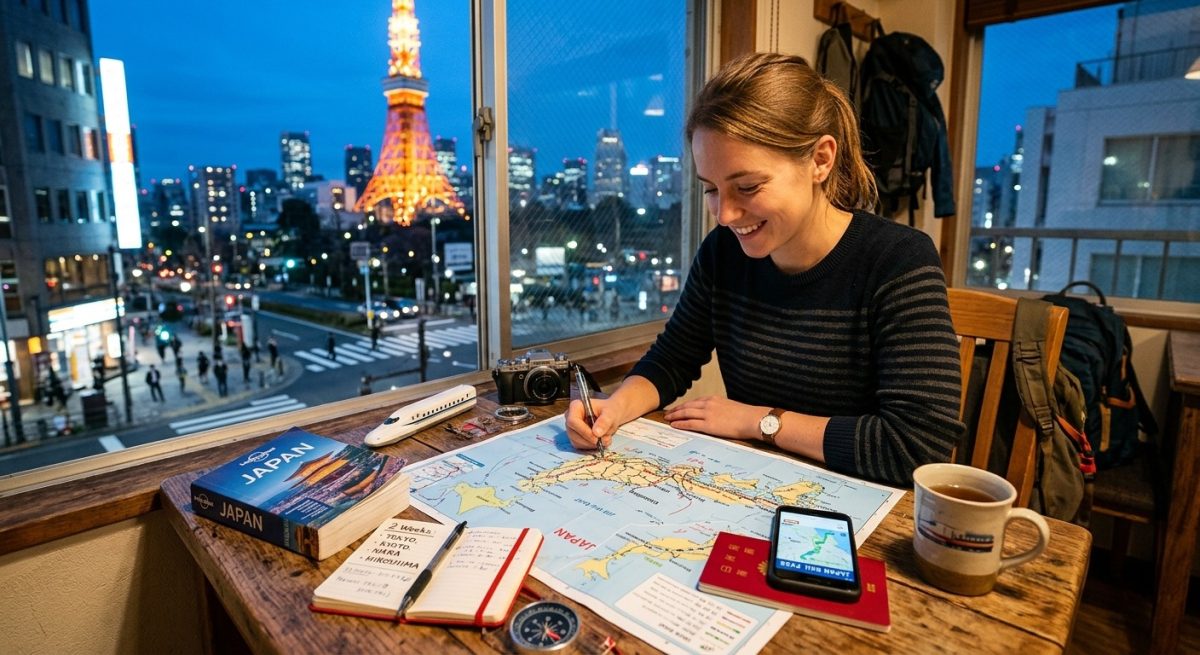
Japan has a reputation for being complicated. The train maps look like abstract art. The language feels impenetrable at first glance. The booking systems occasionally seem designed for someone who already lives there. And yet, Japan consistently ranks as one of the most straightforward countries in the world to travel independently, precisely because the infrastructure works so well. Trains run on time, to the minute. Streets are safe. Convenience stores stock everything you forgot to pack and stay open at 3 a.m. You do not need a tour group to get around. You need a realistic plan, a few logistics sorted before you land, and the willingness to own your own itinerary.
Before You Book a Single Thing: Three Facts That Shape Everything
- Two weeks gives you enough time to cover Tokyo, Kyoto, Osaka, and one meaningful regional detour without feeling rushed.
- The JR Pass pays for itself on most 14-day routes, but you must buy it before you arrive in Japan.
- Independent planning with the right tools costs less and gives you more control than any packaged tour on the market.
Why Two Weeks Is the Right Length for a First Japan Trip
A week in Japan is not enough. Two of those days disappear to jet lag and disorientation, and the rest pass in a blur of bullet trains and temple gates. Three weeks, for a first visit, can start to feel unfocused without a very deliberate plan. Two weeks, structured well, hits the balance point that experienced Japan travelers recommend again and again.
Fourteen days lets you spend real time in Tokyo without cramming. It gives you three or four nights in Kyoto, which is the minimum to scratch the surface of a city that rewards slow attention. It leaves space for a detour to Hiroshima, Nara, or Hakone. And it builds in one buffer day for the inevitable: a neighborhood you did not expect to love, a ramen shop you cannot leave, a local market nobody put in any guide you read.
The key tension in planning this trip is not about how many cities to include. It is about how you balance depth against breadth. Tokyo alone could absorb two weeks. Choosing to leave it after five days is a deliberate trade-off, and making that trade-off deliberately is what separates a trip you feel good about from one that leaves you wondering what you missed.
Choosing a Route That Actually Holds Together
Most two-week Japan itineraries follow the same logical spine: fly into Tokyo, move southwest along the Shinkansen corridor through Kyoto and Osaka, and fly home from Kansai International Airport outside Osaka. This is not a lack of imagination. It is sound geography. The Tokaido Shinkansen line connects those three cities with trains running every ten to fifteen minutes at speeds that make domestic flights irrelevant.
The real planning decisions happen around that spine. Do you stop in Hakone for the mountain scenery and a night in a traditional inn? Do you add a day in Hiroshima and take the ferry to Miyajima? Do you detour north to Kanazawa, which draws a fraction of Kyoto’s crowds with comparable traditional architecture?
Here is a solid framework for the classic 14-day route:
- Days 1 to 2: Arrive in Tokyo. Recover, walk slowly, orient. Shinjuku and Asakusa are both strong first-night neighborhoods with good access to transit.
- Days 3 to 5: Tokyo deep-dive. Harajuku, Shibuya, Yanaka, Akihabara, the Sumida River. Pick what fits your interests, not a generic top-ten list.
- Day 6: Day trip to Kamakura for the giant Buddha and coastal atmosphere, or Nikko for those who want elaborate shrine architecture with fewer crowds.
- Day 7: Shinkansen to Kyoto. Check in and do one neighborhood that afternoon. Gion at dusk is as atmospheric as the photographs suggest.
- Days 8 to 9: Kyoto temples, shrines, and side streets. Fushimi Inari before 7 a.m. to beat the crowds. Arashiyama bamboo grove even earlier.
- Day 10: Day trip to Nara. Feed the deer. Visit Todai-ji. Return to Kyoto for the evening.
- Day 11: Shinkansen to Hiroshima. Visit the Peace Memorial Park in the morning. Ferry to Miyajima for the floating torii gate in the afternoon. Sleep in Hiroshima.
- Day 12: Shinkansen to Osaka. Check in, walk Dotonbori, eat takoyaki from a street stall.
- Days 13 to 14: Osaka neighborhoods, street food at Kuromon Market, Osaka Castle, and one free morning to catch whatever you missed.
How the Main Route Variations Compare
If the classic corridor does not match your priorities, here is how the main alternatives stack up against each other:
| Route Focus | Key Stops | Best For | JR Pass Value |
|---|---|---|---|
| Classic Corridor | Tokyo, Kyoto, Osaka, Hiroshima | First-time visitors | Strong |
| Nature and Cities | Tokyo, Hakone, Matsumoto, Kyoto | Hikers and photography travelers | Strong |
| Off the Beaten Path | Tokyo, Kanazawa, Takayama, Kyoto | Crowd-averse and return visitors | Moderate |
| Deep South | Osaka, Kyoto, Hiroshima, Fukuoka | Food-focused travelers | Strong |
The JR Pass Decision, and Why Timing Matters More Than the Math
The Japan Rail Pass covers unlimited travel on most JR trains nationwide, including Shinkansen bullet trains between major cities, for a fixed number of consecutive days. The 14-day pass is what most two-week travelers buy. It costs roughly $500 to $600 USD depending on current rates, and it has one critical condition: you must purchase it outside Japan before you arrive.
You buy it from an authorized overseas agent or online retailer, receive an exchange voucher, and then swap that voucher for the physical pass at a JR exchange office at the airport when you land. Attempting to buy it after arrival is not an option.
Is it worth the price? For the classic corridor itinerary, the math almost always works in favor of the pass. A single Tokyo-to-Kyoto Shinkansen ticket costs around 13,000 to 14,000 yen. Add a Kyoto-to-Hiroshima segment, a Hiroshima-to-Osaka leg, and all the JR local trains in between, and you recover a large portion of the pass cost before counting the airport express trains or day-trip routes. Regional pass alternatives exist for more focused trips, and Japan’s official tourism authority publishes clear guidance on which regional option makes sense for narrower corridors.
The JR Pass loses its value fast on trips that stay within one city for the bulk of two weeks. Tokyo alone does not justify it. A Kyoto-only trip does not either. The pass earns its cost through long-distance Shinkansen travel, and the classic 14-day itinerary delivers exactly that.
How Independent Travelers Actually Research and Build This Trip
Tour agencies charge a premium for something you can build yourself in a focused afternoon. The research workflow for an independent Japan trip involves several overlapping tasks happening in roughly the same sitting: confirming train times and costs, checking hotel availability by neighborhood, mapping walking distances between sites, and cross-referencing local festival calendars to avoid booking peak weekends accidentally.
Dedicated travel planning tools have largely replaced the agency model for independent travelers doing this kind of multi-city trip research. They pull together route logic, accommodation filtering, and logistics into one workflow instead of requiring eight open browser tabs, which matters when you are piecing together four or five cities across two weeks.
The honest research sequence looks like this:
- Fix your in and out airports first. Most travelers fly into Tokyo (Narita or Haneda) and fly home from Osaka (Kansai International). Lock these before building anything else.
- Block the three anchor cities, Tokyo, Kyoto, and Osaka, before adding optional stops. Everything else fits around them.
- Verify your Shinkansen legs on Google Maps Japan or Hyperdia before committing to hotel locations. Train schedules determine where it makes sense to sleep.
- Book Tokyo and Kyoto accommodations earlier than you think necessary. Both cities fill up fast during cherry blossom season (late March to early April) and autumn foliage season (mid-November).
Day-to-Day Logistics That Catch First-Timers Off Guard
Nobody forgets to book flights. What tends to catch independent travelers in Japan is the smaller operational stuff that nobody thinks about until they are standing in a train station at 11 p.m. with heavy bags.
Start with an IC card. Pick up a Suica or Pasmo card at the airport on arrival, load it with cash, and use it for every subway ride, local bus, and convenience store purchase for the entire trip. It works across virtually the entire country’s transit network and removes a dozen small friction points per day.
Pocket Wi-Fi or a local SIM is not optional for independent travel in Japan. You need maps, translation apps, train schedules, and restaurant hours constantly. Book a pocket Wi-Fi device in advance online, pick it up at a counter in the arrivals hall, and return it there before departure.
Cash still matters here in ways that surprise most Western travelers. Many smaller restaurants, local temples, and rural businesses are cash-only. 7-Eleven ATMs accept foreign cards reliably. Keep at least 10,000 yen accessible at any given time.
- Luggage forwarding (takuhaibin) services let you ship bags between hotels for roughly 1,000 to 2,000 yen per bag. Using this service when moving between cities means you travel light on the Shinkansen instead of wrestling heavy cases through crowded carriages.
- Google Maps works better for transit routing in Japan than almost any dedicated travel app. Use it for walking directions, train timing, and finding restaurants within a few blocks of wherever you are standing.
- Shinkansen reserved seats cost nothing extra and can be booked at JR ticket offices. Make reservations for all your long-distance legs, especially during peak travel periods, to guarantee a seat rather than standing in the non-reserved car.
Where You Stay and Why Neighborhood Matters in Japan
Accommodation in Japan covers more ground than most countries. Western-style business hotels from chains like Toyoko Inn or APA deliver clean, functional rooms at predictable prices. Capsule hotels are affordable and surprisingly comfortable for solo travelers who do not need much more than a private sleeping pod and shared bathrooms. Ryokan, traditional inns with tatami floors, futon beds, and multi-course kaiseki dinners, are worth at least one night on a two-week trip. Hakone and smaller towns in Kyoto’s outskirts are the best places to experience them.
Neighborhood choice matters more in Japan than in most cities, because the transit network is so central to how you move. In Tokyo, staying near a major JR or subway hub saves 20 to 30 minutes of commuting every single day across two weeks. Shinjuku, Akihabara, and Asakusa are all strong base options with excellent onward connections. In Kyoto, the area around Kyoto Station trades historic atmosphere for convenience. Staying in Gion or near Nijo Castle puts you closer to the traditional neighborhoods but adds a short bus or subway leg to the Shinkansen.
The Trip That Belongs to You, Not a Brochure
The version of Japan that tour groups sell is organized and comfortable and efficient. You arrive where you are told, leave when the group leaves, and eat where the contract directs you to eat. It is a perfectly reasonable way to see the landmark highlights. It is a poor way to experience a country this layered and specific.
Planning your own two-week Japan trip takes a few hours of real effort upfront. The research is genuinely enjoyable once you get into it. Route decisions become interesting problems to solve. Logistics fall into place with the right approach. And the result is an itinerary that fits your actual pace, your actual interests, and your actual budget, not whatever packages well for a group of twenty strangers.
The moment you step off the plane at Narita with your JR Pass voucher in hand, your first hotel already booked in the right neighborhood, and a 14-day plan that reflects choices you actually made, the trip stops being abstract and starts being real. Japan, traveled on your own terms, rewards that preparation in ways that no guided tour can replicate.