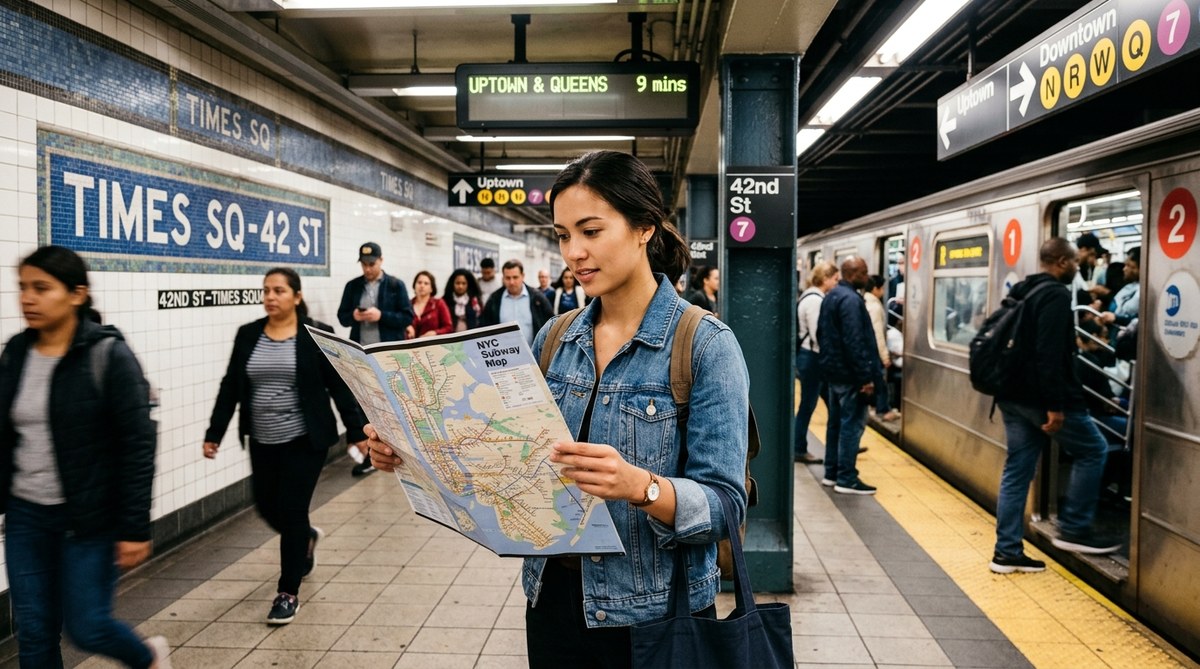
The first time you step into a New York City subway station, it can feel like you have entered a secret underground city. The screech of trains, the rush of warm air, the maze of signs pointing in every direction. It is loud, fast, and honestly a little overwhelming. But here is the truth: the NYC subway is not actually that hard to use. Millions of people ride it every single day, from school kids to business executives to tourists with suitcases. Once you learn a few basic rules, you will wonder why you were ever nervous. This NYC subway guide for beginners will walk you through everything you need to know, from buying your fare to knowing which train to board.
The NYC subway is simpler than it looks. Start by downloading a transit app like Citymapper or Google Maps. Use OMNY to pay with your phone or credit card. Always check if your train is local or express. Look for the Uptown or Downtown signs before you go through the turnstile. With these three steps, you will move through the system like a New Yorker.
How to Pay for Your Ride in 2026
Gone are the days of fumbling for a MetroCard at the last second. The MTA has fully switched to OMNY, a contactless payment system that works with your phone, credit card, or a reusable OMNY card. You tap at the turnstile and walk through. It is that simple.
Here is how to pay step by step:
- Check your wallet for a contactless symbol. Look for the four curved lines on your credit card or phone. Most new cards and phones have it.
- Hold your card or phone over the OMNY reader. You will see a green checkmark and hear a beep. Do not tap more than once.
- Walk through the turnstile. The fare is $2.90 per ride as of 2026. If you are using a phone, Apple Pay and Google Wallet both work.
- If you prefer cash, buy an OMNY card at any station vending machine. You can load it with cash or a card. The machine gives clear instructions.
- Unlimited ride options still exist. A 7-day unlimited MetroCard costs $34 and works on subways and local buses. You can buy one at a vending machine, but note that it uses the old MetroCard system, not OMNY. For most visitors, tapping with your phone is the easiest choice.
Expert advice: Keep your payment method in an easy-to-reach pocket. You will tap it many times over a weekend, and digging through a bag at a crowded turnstile is no fun.
Reading the Map and Finding Your Direction
The subway map looks like a rainbow of tangled spaghetti, but it follows a logical system. Each train line has a letter or number (like the A train or the 6 train) and a color that represents the main trunk line in Manhattan. The red line is the 1, 2, and 3. The green line is the 4, 5, and 6. The blue line is the A, C, and E. This color coding helps you see at a glance which part of the city a train serves.
The most important skill for any beginner is knowing whether you need to go Uptown or Downtown. In Manhattan, Uptown means north, and Downtown means south. If you are at 42nd Street and want to go to 86th Street, you need an Uptown train. If you are at 42nd Street and want to go to 14th Street, you need a Downtown train.
To find your way:
- Look for the large black and white signs hanging from the station ceiling. They say “Uptown & The Bronx” or “Downtown & Brooklyn.”
- Do not enter through the turnstile until you have checked the direction. Once you are inside, you might have to go back out and re-enter on the other side.
- Use a transit app. Google Maps, Citymapper, and the MTA’s own app all show real-time arrivals and tell you which platform to use.
Local vs. Express Trains
This is where most beginners get confused. On many lines, there are two types of trains running on the same tracks: local and express. A local train stops at every station. An express train skips some stations to save time.
| Situation | Local Train | Express Train |
|---|---|---|
| You are in a hurry and your stop is far away | Choose express | Skips up to 4 stations at a time |
| Your stop is a small station with a circle on the map | Choose local | Express will skip it |
| You are not sure which to take | Choose local | You will never miss your stop |
| It is late at night or on weekends | Choose local | Express trains often do not run |
How to tell them apart: Look at the front and side of the train. The digital sign will say either “Local” or “Express.” The station signs on the platform also list which trains stop there.
Common Mistakes Beginners Make (And How to Avoid Them)
Everyone makes mistakes on their first few subway rides. Here are the most common ones and how to fix them.
- Going through the wrong turnstile. Some stations have separate entrances for Uptown and Downtown. If you go through the wrong one, you may need to exit and walk around the block. Always check the signs before you tap.
- Boarding an express train by accident. You are standing on a platform waiting for the 6 train. A train pulls in, but it is the 4 train, which is express. You hop on because it is there. Now you are flying past your stop. Always check the letter or number on the train before stepping inside.
- Not knowing the last stop. When you board a train, look at the map to see the terminal station. If you need to go to Brooklyn, do not board a train that ends in Manhattan. The conductor announces the last stop, but it is easy to miss.
- Blocking the doors. New Yorkers are in a hurry. Stand to the side of the doors when the train pulls in so people can exit. Then step on.
- Using the wrong app. Some apps show driving directions instead of transit. Stick with Google Maps, Citymapper, or Transit. They are the most reliable for subway routing.
Night and Weekend Service Changes
The subway runs 24 hours a day, but the schedule changes on nights and weekends. Trains run less frequently, and some lines switch to local-only service. Express trains often stop running after 10 PM on weeknights and all day on weekends.
What to watch for:
- Weekend track work. The MTA posts service change notices on station walls and on its website. You can also see them in your transit app. A train might be re-routed or replaced by a shuttle bus.
- Late night waits. After midnight, trains come every 15 to 20 minutes. Bundle up if it is cold and be patient.
- Same platform, different service. Sometimes both the local and express trains use the same track on weekends. Check the digital sign on the train to confirm it stops at your station.
- Plan an extra 15 minutes. If you have a dinner reservation or a show to catch, add 15 minutes to your travel time during off-peak hours.
The Best Tools for a Stress-Free Ride
You do not need to memorize the map. You just need the right tools.
- Citymapper is the best app for real-time subway directions. It tells you exactly which car to board for the easiest exit.
- Google Maps works great and most people already have it. It shows live delays and platform numbers.
- The MTA app is free and shows service changes, elevator outages, and station information.
- A portable charger. Your phone is your lifeline underground. Keep it charged.
- A backup payment method. If your phone dies, you will want a physical card or cash.
What to Do If You Get Lost
Getting lost on the subway happens to everyone, even locals. Here is what to do.
- Stay calm. You are not stuck. Every station has an exit.
- Walk to the nearest station agent booth. Most stations have a booth with a real person inside. They can help you with directions.
- Use your phone. Step away from the crowd, open your transit app, and type in your destination. The app will reroute you.
- If you go in the wrong direction, just get off. Ride one stop in the opposite direction to get back on track. You do not need to pay again.
- Ask someone. New Yorkers are friendlier than their reputation. A simple “Excuse me, is this train going to Union Square?” works wonders.
Why the Subway Is Still the Best Way to See NYC
No other form of transit in New York City comes close to the subway. Taxis and ride-shares get stuck in traffic. Buses are slow. Walking is great but impractical for long distances. The subway connects all five boroughs and runs 24 hours. A single ride costs less than three dollars. For the price of one cab ride, you can crisscross the city all day.
If you are planning a trip that covers multiple neighborhoods, the subway is your best friend. You can start your morning in the East Village, ride up to Central Park for a stroll, then head over to Williamsburg for dinner, all for under ten dollars. Compare that to the cost of a rental car or the time lost in traffic.
For more ideas on how to spend your time in the city, take a look at our guide to 5 off-the-beaten-path museums in New York City that even locals love. And if you are still deciding where to base yourself, read our breakdown of what’s the best neighborhood to stay in New York City for first-timers.
You Have Got This
The NYC subway is not a puzzle that only locals can solve. It is a public transit system built to move millions of people every day. You are one of those people now. Tap your phone, check the sign, and board your train. If you make a wrong turn, get off and try again. That is exactly what everyone else does.
Your first ride might feel like a small victory. By your third ride, you will be giving directions to someone else. That is the beauty of this city. The subway teaches you confidence, patience, and a little bit of street smarts. And once you have mastered it, the whole city opens up to you.