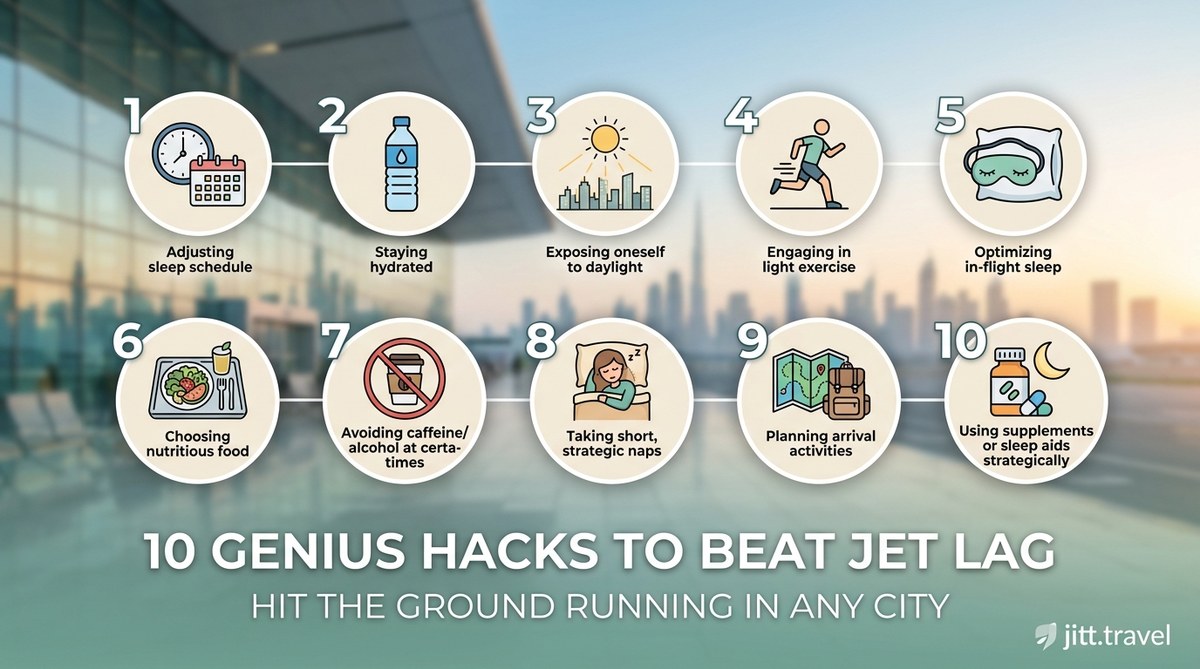
You step off the plane in a new city, and your body is still living in a time zone that is six hours behind. Your brain feels foggy. Your eyes are heavy. You want to sleep, but it is only 2 p.m. local time. That is jet lag, and it can steal the first two days of any trip. The good news is that you do not have to suffer through it. With a few targeted jet lag hacks, you can force your internal clock to sync up with your destination before you even unpack your bag.
Jet lag happens when your circadian rhythm is out of sync with local time. The most effective hacks involve manipulating light exposure, timing your meals, and using strategic sleep windows. Start adjusting before your flight, use light therapy upon arrival, and avoid long naps. These methods are backed by sleep science and used by professional athletes and pilots to perform at their best across time zones.
Why Your Body Clock Fights You
Your body runs on a roughly 24-hour cycle called the circadian rhythm. It is controlled by a cluster of nerves in your brain that respond to light. When you fly across three or more time zones, your internal clock does not match the local day-night cycle. That mismatch creates jet lag.
Symptoms include fatigue, trouble sleeping, irritability, digestive issues, and brain fog. The general rule is that it takes about one day per time zone crossed for your body to fully adjust. But you can speed that up dramatically.
The Pre-Flight Window Matters Most
Most travelers ignore the 48 hours before a trip. That is a mistake. Your body can start adapting to a new schedule before you ever leave home.
- Shift your sleep schedule gradually. If you are flying east, go to bed 30 minutes earlier each night for three nights before departure. If you are flying west, do the opposite. Go to bed 30 minutes later each night.
- Set your watch to destination time as soon as you board. This trains your brain to think in the new time zone.
- Eat according to destination meal times. Your digestive system sends strong signals to your brain about when to be awake and when to sleep. Eating a meal at the time your destination serves breakfast tells your body it is morning.
Light Is Your Most Powerful Tool
Light is the strongest cue for resetting your circadian rhythm. It works better than caffeine, melatonin, or any sleep aid.
When you arrive, seek bright light at the right time of day.
- Morning arrival (before noon local time): Get outside immediately. Sunlight tells your brain it is daytime and suppresses melatonin production. A 30-minute walk in the sun can shift your clock by two hours.
- Afternoon arrival (noon to 6 p.m.): Stay in bright light until sunset. Do not retreat to a dark hotel room.
- Evening arrival (after 6 p.m.): Avoid bright light. Use dim lighting and blue-light blocking glasses. Your brain needs darkness to produce melatonin and prepare for sleep.
“Light exposure is the single most effective intervention for jet lag. Timing is everything. A walk in the sun at the wrong hour can actually make jet lag worse by telling your body it is night when it should be day.” — Dr. Colleen Ehrnstrom, sleep psychologist and author
The Nap Trap
You arrive exhausted. Your hotel bed looks perfect. You tell yourself, “Just one hour.” That is a trap.
Long naps after arrival keep your body anchored to your home time zone. If you must nap, set a strict limit.
- Nap for no more than 20 minutes.
- Set two alarms. One for 20 minutes and one for 25 minutes.
- Nap in a chair, not in bed. This prevents you from slipping into deep sleep.
A 20-minute power nap can restore alertness without interfering with your ability to fall asleep at the correct local bedtime.
Eat Your Way to a New Time Zone
Your stomach has its own clock. It is called the peripheral circadian rhythm, and it can be reset faster than your brain clock. You just need to feed it on the right schedule.
| What to do | When to do it | Why it works |
|---|---|---|
| Eat a high-protein breakfast | Within 30 minutes of waking local time | Protein boosts dopamine and promotes alertness |
| Eat a light lunch | Around noon local time | Keeps energy steady without causing drowsiness |
| Eat a carbohydrate-heavy dinner | 2-3 hours before local bedtime | Carbs help produce serotonin, which aids sleep |
| Avoid caffeine | After 2 p.m. local time | Caffeine blocks adenosine and can delay sleep onset |
Avoid heavy, greasy meals late at night. Your digestive system slows down during sleep, and a full stomach can disrupt your rest.
Melatonin: Use It Correctly
Melatonin supplements can help, but most people use them wrong. Melatonin is not a sleeping pill. It is a timing signal. It tells your brain that it is time to prepare for sleep.
- For eastbound travel (jet lag that makes you wake up too early): Take 0.5 to 3 mg of melatonin at your target bedtime in the new time zone.
- For westbound travel (jet lag that makes you stay up too late): Take melatonin 30 minutes before your desired bedtime to help you fall asleep earlier.
- Never take melatonin in the middle of the night. That can shift your clock in the wrong direction.
Start with a low dose. Higher doses do not work better and can cause grogginess the next day.
Hydrate Aggressively
Airplane cabins have humidity levels around 10 to 20 percent. That is drier than the Sahara Desert. Dehydration worsens every symptom of jet lag, including fatigue, headache, and brain fog.
- Drink one liter of water for every four hours of flight time.
- Avoid alcohol and caffeine during the flight. Both are diuretics that dehydrate you.
- Continue drinking water throughout your first day at the destination.
Move Your Body
Exercise helps reset your circadian rhythm. It also reduces the inflammation that builds up during long flights.
- Morning exercise: A brisk walk, jog, or yoga session after sunrise accelerates your body’s wake-up process.
- Afternoon exercise: Light movement prevents the afternoon slump.
- Evening exercise: Avoid intense workouts within two hours of bedtime. They raise your core temperature and make it harder to fall asleep.
If you are visiting a walkable city, skip the taxi or subway for your first day. Walk to your destinations. The combination of light exposure and movement is powerful.
The Strategic Airport Nap
If you have a long layover, a short nap in the airport can help reset your energy. But you need to be smart about it.
- Find a quiet gate away from announcements.
- Use a travel pillow and eye mask.
- Set a timer for 20 minutes.
- Do not sleep longer than 30 minutes. Longer naps cause sleep inertia, which is that groggy, disoriented feeling that can last for hours.
Some airports now have nap pods or quiet rooms. Check your airport’s website before you travel.
Put These Hacks Together
A single hack will not fix jet lag. You need a system. Here is a sample plan for a traveler flying from New York to London (a five-hour time difference eastward).
Two days before the flight:
– Go to bed 30 minutes earlier each night.
– Start eating meals one hour earlier than usual.
Day of the flight:
– Set your watch to London time before boarding.
– Drink water throughout the flight. No alcohol.
– Sleep on the plane if it is nighttime in London. Stay awake if it is daytime in London.
Arrival (10 a.m. London time):
– Do not nap.
– Walk outside for 45 minutes in the sunlight.
– Eat a protein-heavy breakfast.
– Stay active until at least 8 p.m. local time.
First evening:
– Eat a carb-heavy dinner at 7 p.m.
– Take 1 mg of melatonin at 9 p.m.
– Sleep in a completely dark room.
– Wake up at 7 a.m. the next morning. No snooze button.
Common Mistakes to Avoid
Even experienced travelers make these errors. Watch out for them.
- Sleeping in on your first morning. This anchors you to your old time zone. Get up when your alarm goes off, even if you only slept five hours.
- Staying in your hotel room all day. Darkness encourages sleep. Get outside and expose yourself to natural light.
- Drinking coffee at 4 p.m. You will regret it at bedtime. Caffeine has a half-life of about five hours.
- Using your phone in bed at night. Blue light from screens suppresses melatonin. Use night mode or stop using devices one hour before bed.
- Binge eating at odd hours. Your digestive system needs consistent meal times to reset.
When to See a Doctor
Most jet lag resolves on its own within a few days. But if you experience severe symptoms that last more than a week, or if you have trouble sleeping after returning home, talk to a doctor. Some underlying sleep disorders can mimic jet lag.
If you travel frequently for work, a sleep specialist can help you create a personalized plan that matches your routes and schedule.
Make Your First Day Count
Jet lag does not have to ruin your trip. By using these science-backed hacks, you can show up in a new city feeling alert, energized, and ready to explore. Whether you are walking the streets of Rome, navigating the metro in Tokyo, or closing a business deal in London, your body will be on your side.
Start with the pre-flight adjustments. Use light strategically. Eat on local time. Move your body. And give yourself grace if you feel off for a day or two. Even with the best hacks, your body needs time to adapt. But with these strategies, you can cut that adaptation time in half.
Now go enjoy your trip. You earned it.