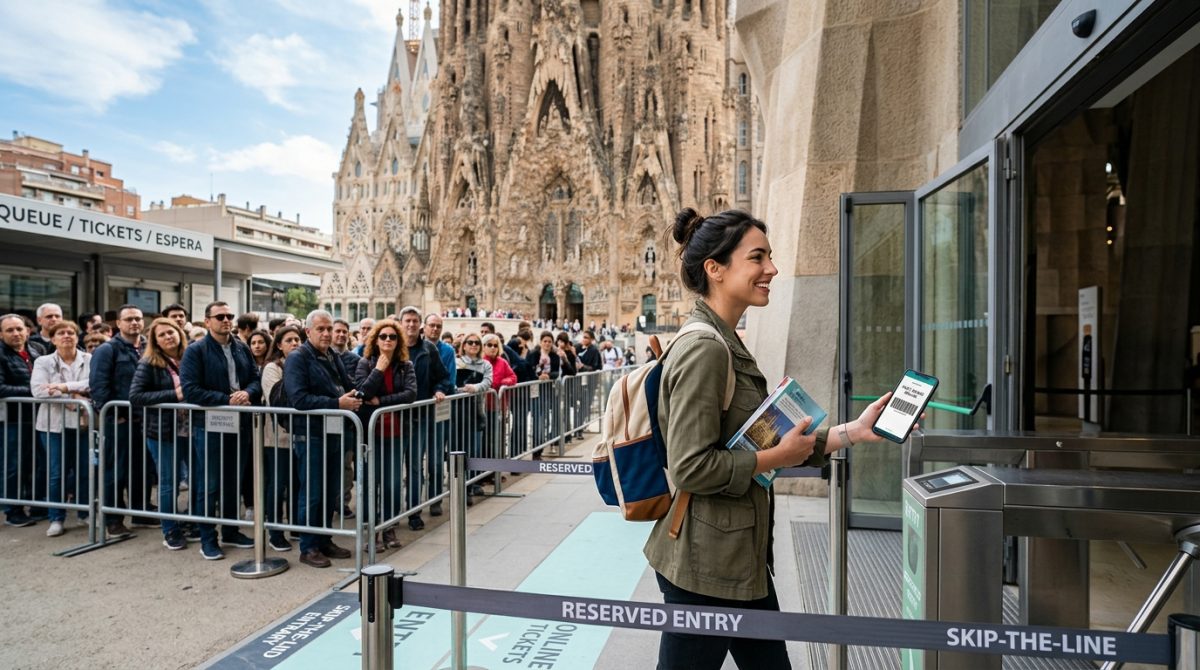
Standing in a two-hour line under the blazing sun while your vacation clock ticks away feels like torture. You watch VIP ticket holders breeze past, and you wonder if there’s a middle ground between wasting half your day and dropping an extra $100 per person.
Good news: there is.
You can bypass long lines at major tourist attractions without purchasing expensive skip-the-line tickets by timing your visits strategically, using free reservation systems, entering through alternate entrances, and taking advantage of off-peak hours. These budget-friendly tactics require planning but can save you hours of waiting and hundreds of dollars per trip.
Arrive at Opening Time or Just Before Closing
Most tourists start their day slowly. They sleep in, have a leisurely breakfast, and arrive at attractions between 10 AM and 2 PM. That’s exactly when lines peak.
Set your alarm early instead. Arrive 30 minutes before the official opening time. You’ll join a much smaller crowd, and once the gates open, you’ll be among the first inside.
The same principle works in reverse. Many attractions stay open until 6 PM or later, but most visitors leave by 4 PM to grab dinner. Arriving two hours before closing means you’ll face minimal lines and often get a bonus: sunset lighting for photos at outdoor attractions.
This strategy works especially well at museums, observation decks, and historical sites. Theme parks require a different approach since rides close for maintenance near closing time.
Use Free Advance Reservation Systems
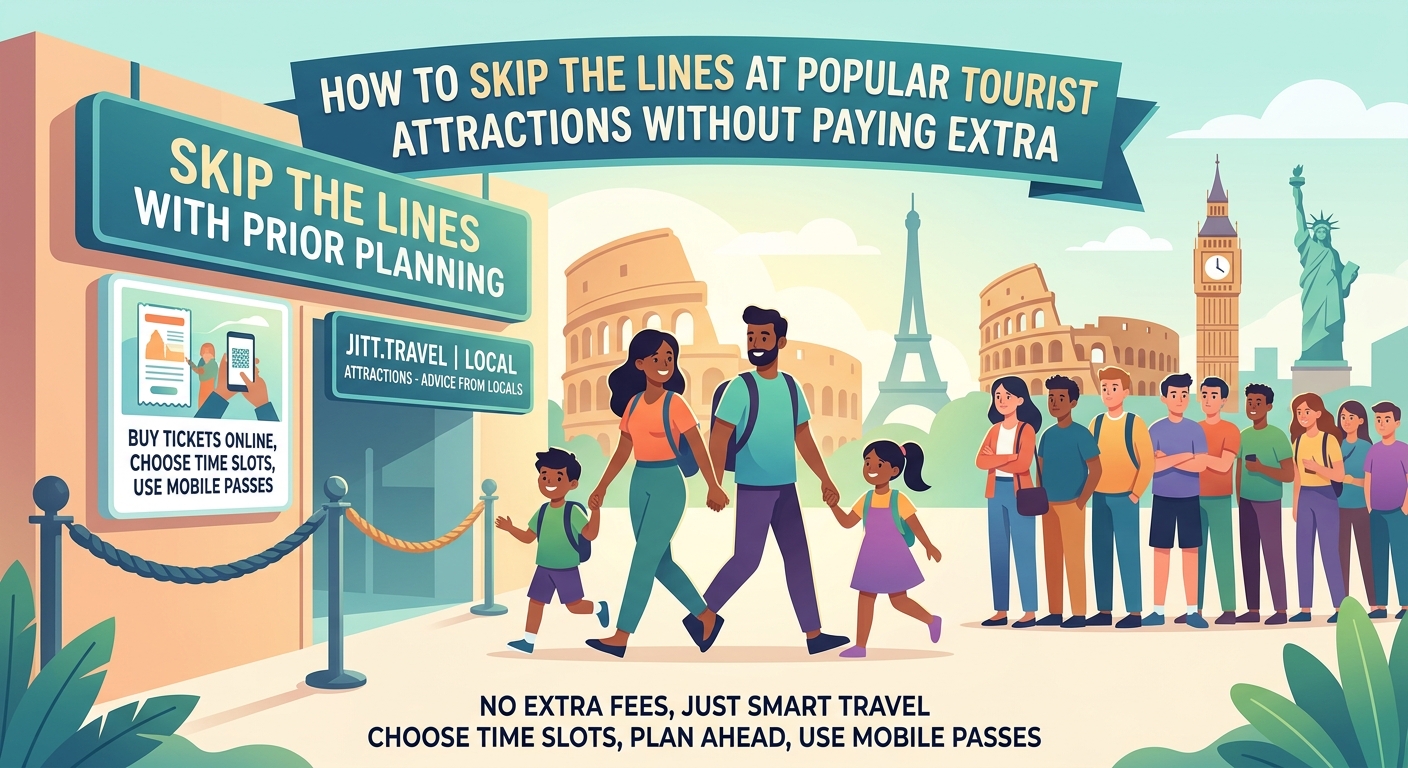
Many popular attractions now offer free timed entry reservations. These aren’t skip-the-line tickets. They’re free booking systems that limit capacity and eliminate standby lines entirely.
Here’s how to find them:
- Visit the official attraction website directly, not third-party booking sites
- Look for sections labeled “Plan Your Visit” or “Book Tickets”
- Check if they offer timed entry slots or free reservations
- Book your slot weeks in advance, especially for summer and holiday travel
The Louvre, Uffizi Gallery, Anne Frank House, and dozens of other major attractions use this system. You still pay the regular admission price, but you walk straight in at your reserved time while standby visitors wait for hours.
Some attractions hide this option. They promote paid skip-the-line tickets prominently while burying the free reservation system in fine print. Always check the official website carefully before assuming you need to pay extra.
Target Off-Season and Shoulder Season Dates
Peak season exists for a reason. Summer vacation, spring break, and major holidays bring massive crowds. Shifting your travel dates by just a few weeks can cut wait times by 70% or more.
Consider these timing strategies:
- Visit European cities in November or March instead of July
- Plan theme park trips for September or early May
- Schedule museum visits during school term time, not holidays
- Avoid three-day weekends and the week between Christmas and New Year
Weather might be slightly less perfect, but you’ll spend less time standing still and more time actually experiencing what you came to see.
Shoulder season travel also costs less for flights and hotels, multiplying your savings beyond just skipped line fees.
Enter Through Side or Back Entrances
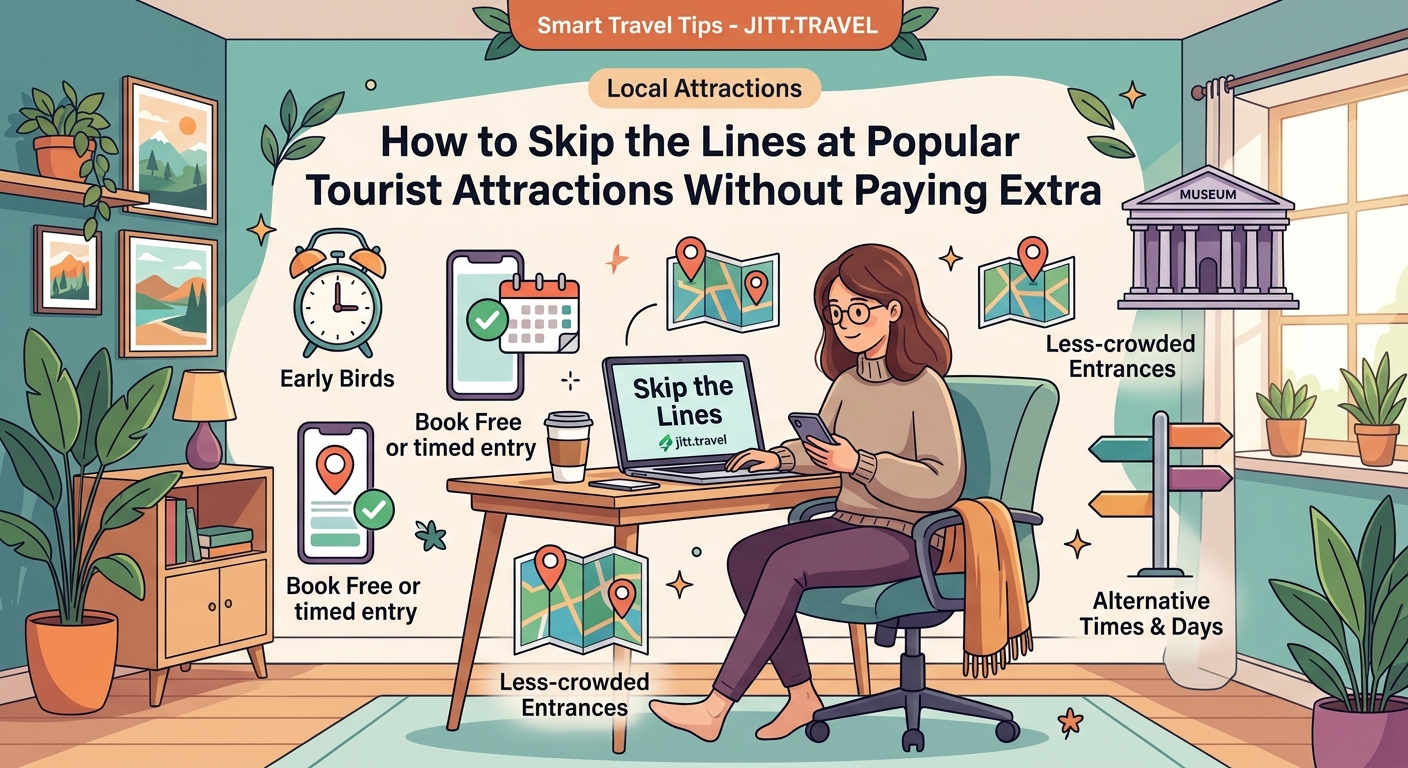
Major attractions often have multiple entry points. The main entrance gets 90% of the traffic because it’s obvious and well-marked. Alternative entrances stay nearly empty.
Before your visit, study the attraction’s map online. Look for:
- Member or annual pass holder entrances (sometimes open to everyone during off-peak hours)
- Group tour entrances that allow individual visitors during slow periods
- Exits that also function as entrances at certain times
- Connected buildings or wings with separate entry points
The Vatican Museums have a perfect example. Most tourists queue at the main entrance on Viale Vaticano. Fewer people know about the entrance near the Vatican Gardens, which often has a fraction of the wait.
Security staff can tell you if alternate entrances are available. Just ask politely: “Is there another entrance with a shorter line?” They’ll often point you in the right direction.
Visit During Meal Times
Tourist behavior follows predictable patterns. Between noon and 1:30 PM, attraction lines shrink noticeably as visitors break for lunch. The same dip happens around 6 PM for dinner.
Flip the script. Eat breakfast at 10 AM or lunch at 2 PM, then hit attractions during traditional meal hours. You’ll find shorter lines and less crowded galleries.
This works best at attractions located in areas with many restaurants nearby. Visitors naturally leave to eat, creating a temporary lull. Museums, observation decks, and monuments see the biggest impact.
Pack snacks if you get hungry outside normal meal times. A granola bar beats standing in a 90-minute line any day.
Take Advantage of Free Days and Extended Hours
Many museums and cultural sites offer free admission on specific days each month. These free days attract huge crowds, right? Sometimes, but not always.
Free evenings work differently. The first Sunday of the month might be free but packed. The first Thursday evening from 5 to 8 PM might also be free but nearly empty because fewer people know about it.
Check the attraction’s website for:
- Free evening hours on weekdays
- Free admission during the final hour before closing
- Pay-what-you-wish time slots
- Local resident free days (which may include anyone with proof of address in the broader region)
Extended hours during summer or special exhibitions also help. When a museum stays open until 10 PM instead of 6 PM, the crowd spreads across more hours, thinning out the lines.
Use City Tourism Cards Strategically
Most travelers buy city tourism cards for the discounts. The real value is often the line-skipping benefit that comes with them.
Cards like the Paris Museum Pass, Roma Pass, or Barcelona Card include direct entry privileges at dozens of attractions. You’re not buying a skip-the-line ticket. You’re buying a pass that includes admission, and admission holders use a separate, faster entrance.
Do the math before purchasing. If you plan to visit four or five included attractions, the card often pays for itself while saving you hours in lines.
One warning: some tourism cards require you to pick them up at a specific office, which might have its own line. Check pickup locations and hours before you buy. Getting your card from a suburban tourist office with no wait beats collecting it from a crowded central kiosk.
Book Combination Tickets and Bundled Experiences
Attractions sometimes offer combination tickets that include two or three sites for one price. These bundles often come with reserved entry times or separate entrances.
A ticket that combines the Colosseum, Roman Forum, and Palatine Hill might cost the same as buying separately but includes timed entry. You’re getting line-skipping as a side benefit of bundling.
Look for these packages on official attraction websites, not just third-party tour companies. Government-run sites and museum networks frequently offer them at standard prices.
Join Free Walking Tours That Include Skip Access
Free walking tours operate on a tip-based model. You pay what you think the tour was worth at the end. Many people don’t realize these tours sometimes include attractions with separate entry lines for tour groups.
The tour itself is free. The attraction admission still costs money, but you enter through the group entrance, which moves faster than the individual visitor line.
This works at cathedrals, government buildings, and some museums. The tour guide has pre-arranged access, and you benefit from their coordination.
Not every free walking tour includes interior visits. Check the itinerary description carefully. Look for phrases like “includes interior visit” or “entry to [specific attraction].”
Monitor Real-Time Wait Time Apps and Websites
Several apps and websites track current wait times at major attractions. They work like traffic apps but for tourist lines.
Check these resources the morning of your visit:
- Official attraction apps (Disney, Universal, and major museums often have them)
- Google Maps “Popular Times” feature for each location
- Tourism forum posts from people visiting that same day
- Webcams pointed at attraction entrances
If you see wait times spike at your planned destination, pivot to a backup plan. Visit a different attraction now and return to your first choice during an off-peak window.
Flexibility beats rigid itineraries when you’re trying to avoid lines without paying premium prices.
Understand the Difference Between Strategies and Scams
| Strategy | How It Works | Cost | Reliability |
|---|---|---|---|
| Early arrival | Beat the crowds by arriving first | Free | Very high |
| Free reservations | Book timed entry slots in advance | Free | Very high |
| Off-peak timing | Visit during low-traffic hours | Free | High |
| Alternate entrances | Use less-known entry points | Free | Medium |
| City tourism cards | Bundled admission with fast entry | $50-$100 | High |
| Meal-time visits | Visit when others are eating | Free | Medium |
Avoid these common mistakes that waste time or money:
- Buying “skip-the-line” tickets from unofficial resellers at 3x the price
- Joining tour groups you don’t want just for line access
- Assuming all paid tickets include line-skipping (many don’t)
- Skipping research and hoping for the best on arrival
“The best skip-the-line strategy is information. Spend 20 minutes researching each attraction before your trip. Check official websites, recent visitor reviews, and current entry procedures. That small time investment saves hours of standing in the wrong line.” — Seasoned budget traveler
Handle Special Cases and Seasonal Attractions
Some attractions require different approaches:
Theme parks: Arrive at rope drop (official opening), head to the most popular ride first, then work backward through the park as crowds spread out. Single rider lines cut wait times by 60% or more if you don’t mind splitting up your group temporarily.
Observation decks: Sunset is the worst time for lines. Visit at noon or just after opening instead. The view changes, but the wait time drops dramatically.
Religious sites during services: Many cathedrals and churches have separate entrances for worshippers. If you’re comfortable attending a service, you can often enter this way and stay to look around afterward. Be respectful and follow all rules about photography and movement during services.
Seasonal attractions: Christmas markets, Halloween events, and summer festivals get slammed on weekends. Weekday evenings offer the same experience with a fraction of the crowd.
Temporary exhibitions: These draw huge crowds initially, then taper off. If you can wait three or four weeks after opening, you’ll face much shorter lines for the same exhibit.
Combine Multiple Tactics for Maximum Impact
The real magic happens when you stack strategies. Here’s a real example:
You want to visit the Sagrada Familia in Barcelona. Instead of showing up at 11 AM on a Saturday in July and waiting two hours, you:
- Book a free timed entry reservation for 9 AM on a Wednesday in May
- Use a Barcelona Card you already planned to buy for museum discounts
- Arrive 20 minutes early to be first in your time slot
- Enter through the Nativity facade entrance, which sees less traffic than the Passion facade
Result: you walk straight in while the standby line stretches around the block. Total extra cost: zero, because you already wanted the Barcelona Card for other reasons.
This approach works at almost any major attraction. Pick two or three compatible strategies, plan ahead, and execute on the day.
Make Smart Decisions on the Ground
Even with perfect planning, situations change. Lines might be shorter or longer than expected. Weather might affect crowd patterns. Strikes or special events can throw off your timing.
Stay adaptable:
- Check wait times when you arrive, not just before you leave your hotel
- Have backup attractions ready if your first choice is too crowded
- Ask staff about current wait estimates (they often know better than apps)
- Consider splitting up if some group members care more about certain attractions
- Remember that some experiences are worth a moderate wait, just not a three-hour one
Your time has value. Calculate what an hour of your vacation is worth. If a line will take 90 minutes, and you can visit a different amazing attraction with a 15-minute wait instead, that’s often the smarter choice.
Your Vacation Time Belongs to You
Lines at tourist attractions aren’t inevitable. They’re the result of everyone following the same patterns, visiting at the same times, and entering through the same doors.
Break those patterns. Show up early. Book ahead. Use free systems that already exist. Think like a local, not a tourist.
The money you save on skip-the-line tickets can buy an extra nice dinner, a better hotel room, or another day of travel. The time you save standing in lines becomes time actually experiencing the places you came to see.
Start with one or two strategies on your next trip. Once you see how well they work, you’ll never go back to standing in the default line again.