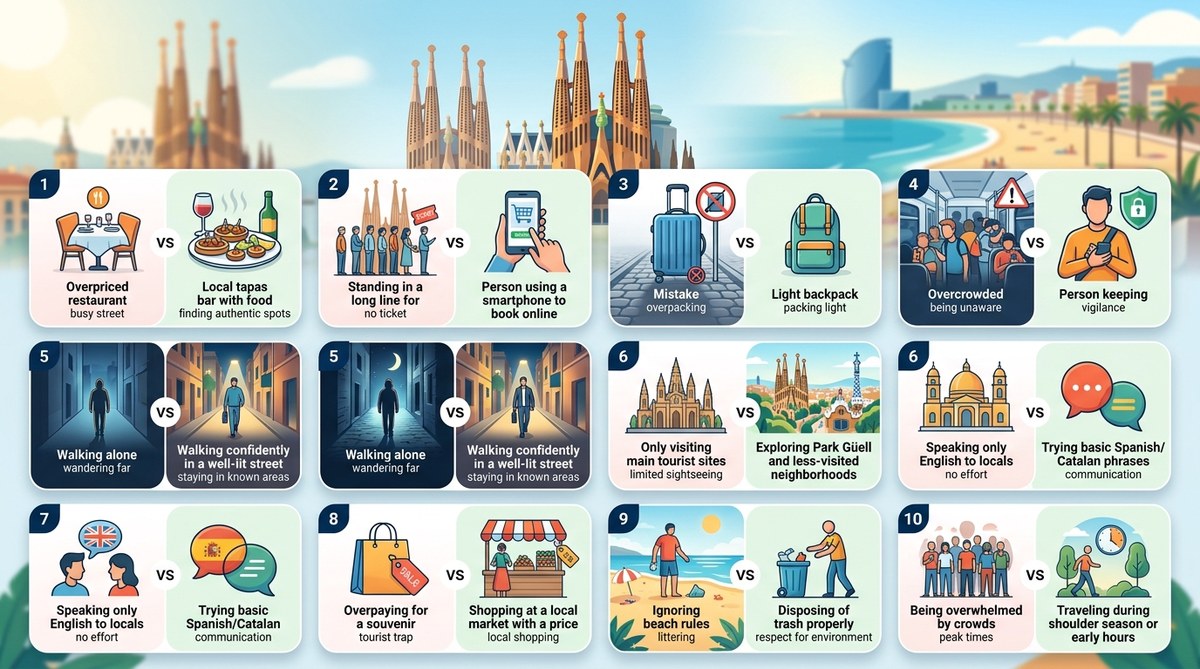
Barcelona hits you with a sensory overload in the best way possible. The smell of the sea, the echo of Catalan in the narrow alleys of the Gothic Quarter, and the impossible shapes of Gaudi’s architecture around every corner. It is a city that begs to be explored. But for all its magic, Barcelona is also a city that rewards preparation. Every year, thousands of travelers lose time, money, and patience by falling into the same predictable traps. The good news? You do not have to be one of them.
Avoiding the biggest tourist mistakes in Barcelona comes down to three things: planning ahead, eating where locals eat, and keeping your belongings secure. Skip the Las Ramblas paella, book your Sagrada Familia tickets at least two weeks out, and never keep your wallet in your back pocket. Do these three things, and you will already have a better trip than 90% of visitors.
The Golden Rule of Tickets: Book Before You Board
The single biggest mistake tourists make in Barcelona is showing up to major attractions without a reservation. In 2026, this is almost a guarantee of disappointment.
Park Guell and Sagrada Familia are not like museums where you can walk up and buy a ticket. They operate on timed entry slots that often sell out days or even weeks in advance. If you arrive at the gate without a ticket, you will be staring at a “Sold Out” sign on your phone screen while standing in a line that does not move.
Here is a practical process to avoid this mistake:
- Check your calendar. Decide which days you want to visit major sites at least two weeks before your trip.
- Book directly. Use the official websites for Sagrada Familia and Park Guell. Third-party resellers often mark up prices or sell confusing combination passes.
- Choose your time slot wisely. Book the first entry of the day (usually 9:00 AM) or the last slot before closing. These windows have the smallest crowds and the best light for photos.
- Download the tickets. Save them to your phone’s wallet app before you leave your hotel. Do not rely on hotel Wi-Fi.
- Set a reminder. Put an alarm for 15 minutes before your slot. Missing your window means losing your money.
If you are the type of traveler who likes to keep things flexible, consider a strategy of visiting smaller attractions that do not require reservations. But for the big two, you must commit.
Eating Paella on Las Ramblas
Las Ramblas is a beautiful, chaotic boulevard. It is also a magnet for overpriced, mediocre food. The paella you see displayed in the windows there is often pre-made, microwaved, and priced at 20 euros for a plate that a local would not touch.
“Real paella is a Sunday lunch dish. It takes 45 minutes to cook from scratch. If a restaurant serves it to you in under 10 minutes, they are cutting corners.” – Maria, owner of a small tapas bar in Gracia.
Do not waste a meal on Las Ramblas. Walk five minutes into the side streets of El Born or Gracia to find a spot where the menu is handwritten in Catalan and the lunch menu includes three courses for under 15 euros.
Ignoring the Metro for Taxis
Barcelona’s metro system is clean, safe, and remarkably efficient. It runs from 5:00 AM until midnight on weekdays, with extended hours on weekends. A single ride costs around 2.40 euros.
Taxis, on the other hand, can get stuck in the city’s narrow streets and heavy traffic. A ride from the airport to the city center can easily cost 35 euros or more, while the metro (Line L9 Sud) gets you there in 30 minutes for a fraction of the cost.
| Transportation Mode | Cost (One Way) | Time (Airport to Placa Catalunya) | Best For |
|---|---|---|---|
| Metro (L9 Sud) | ~5 euros (with T-casual card) | 30 minutes | Solo travelers, light luggage |
| Aerobus | ~7 euros | 35 minutes | Groups, direct service |
| Taxi | 35-40 euros | 25-40 minutes | Late night, heavy luggage, 3+ people |
| Private Transfer | 50+ euros | 25-40 minutes | Business travelers, convenience |
Buy a T-casual card at any metro station machine. It gives you 10 rides for about 12 euros and can be shared among multiple people. It works on buses, trams, and the metro. This is the single best value in the city.
Keeping Your Phone in Your Back Pocket
Pickpocketing is a real problem in Barcelona. It is not about violence; it is about opportunity. Tourists make it easy by leaving phones sticking out of back pockets, hanging bags off the back of chairs, or setting cameras down on cafe tables.
The most common distraction technique involves someone asking for directions or a signature while an accomplice lifts your wallet. Another classic is the “bird poop” scam, where someone squirts liquid on your shoulder and a helpful stranger appears to clean it off, only to disappear with your watch.
- Keep your phone in your front pocket or a zipped bag.
- Wear your backpack on your chest in crowded areas like the metro and Las Ramblas.
- Never hang your purse on the back of a chair. Keep it on your lap with the strap wrapped around your leg.
- Use a money belt or a neck pouch for your passport and backup credit card.
Staying Only in the Gothic Quarter
The Gothic Quarter is atmospheric and historic. It is also packed with souvenir shops, street performers, and crowds that make walking a chore. Many tourists spend their entire trip here and leave thinking Barcelona is just a medieval theme park.
The city has distinct neighborhoods, each with its own personality. El Raval is gritty, artistic, and home to the MACBA museum. Gracia feels like a village with its own plazas and local festivals. Barceloneta is the beach neighborhood, best for seafood and sunsets. Eixample is where you find the modernist buildings and wider, tree-lined streets.
Spend at least one afternoon in Gracia. Walk up to the Park Guell area (the free part, not the ticketed monument) and watch the sunset over the city. You will see a side of Barcelona that most tourists miss entirely.
Eating Dinner at 6:00 PM
American travelers often show up to restaurants at 6:00 PM expecting dinner service. In Barcelona, that is still “merienda” time (snack time). Most restaurants do not open for dinner until 8:30 or 9:00 PM.
If you sit down at 6:00 PM, you will be eating in an empty restaurant with a limited menu. The food will be reheated from lunch. Instead, follow the local rhythm:
- Breakfast: 8:00 – 10:00 AM (coffee and a pastry)
- Lunch: 1:30 – 3:30 PM (this is the main meal of the day)
- Tapas: 8:00 – 9:00 PM (a light snack and a drink)
- Dinner: 9:00 – 11:00 PM (lighter than lunch)
Adjust your schedule for two days, and you will find that the city opens up to you. The best tapas bars are busiest around 9:00 PM, and that is when the energy is highest.
Only Seeing Gaudi Buildings
Antoni Gaudi is a genius. His work is the reason many people visit Barcelona in the first place. But the city has so much more to offer. If you only see Sagrada Familia, Park Guell, and Casa Batllo, you are missing the full picture.
Barcelona has Roman ruins in the Museu d’Historia de Barcelona, a world-class Picasso museum, and a thriving contemporary art scene. The Palau de la Musica Catalana is a stunning modernist concert hall that rivals anything Gaudi built. The Hospital de la Santa Creu i Sant Pau is another modernist masterpiece that is often overlooked.
For a change of pace, walk through the Ciutadella Park on a Sunday afternoon. Locals are out with their families, playing drums, dancing, and selling handmade crafts. It is a slice of real Barcelona life that costs nothing to experience.
Forgetting That Catalonia Has Its Own Culture
Barcelona is the capital of Catalonia, not Spain. This is not a minor detail. The locals speak Catalan first and Spanish second. They have their own traditions, their own flag, and a strong sense of identity.
If you refer to the Catalan language as a dialect of Spanish, you will get a polite but firm correction. If you call the Castellers (human towers) a Spanish tradition, you will get a history lesson.
Show respect by learning a few words in Catalan:
- Bon dia (Good morning)
- Si us plau (Please)
- Gracies (Thank you)
- Adéu (Goodbye)
This small effort goes a long way. Locals appreciate it when visitors acknowledge their culture rather than treating it as a footnote to Spanish tourism.
Wearing Flip-Flops for a Full Day of Walking
Barcelona is a walking city. You will cover 8 to 12 miles a day without even trying. The streets are paved with cobblestones in the old city, and the sidewalks in Eixample are wide but hard on your feet.
Flip-flops, sandals without arch support, and new sneakers that have not been broken in will ruin your trip. You will be limping by 3:00 PM and missing out on evening plans.
Wear comfortable walking shoes that you have worn before. Bring a pair of sandals for the beach and the evening, but keep your walking shoes for the daytime sightseeing. Your feet will thank you.
Thinking You Can “Just Show Up” at the Beach
Barceloneta beach gets packed. On a sunny Saturday in July, you will be lucky to find a square meter of sand to call your own. The water can be cloudy, and the vendors selling drinks and massages are relentless.
The mistake is thinking this is the only beach in Barcelona. It is not. Take the metro to L4 and ride it to the end of the line. Nova Icaria, Bogatell, and Mar Bella are less crowded and cleaner. Mar Bella even has a designated nudist section if that is your preference.
Better yet, take a day trip to the beaches of the Costa Brava (north of the city) or Sitges (south). They are an hour away by train and offer clearer water and more space.
How to Avoid These Mistakes in 2026
The city is constantly evolving. New rules about short-term rentals and tourist taxes are being discussed. But the core advice remains the same: plan ahead, eat where locals eat, respect the culture, and keep your valuables secure.
If you want to learn more about seeing a city without the crowds, check out our guide on the best time to visit top attractions to avoid crowds. For those looking to save money on food, our article on budget eating in expensive cities has strategies that work in Barcelona too.
Your Barcelona Trip Starts With Smart Choices
Barcelona is not a difficult city to love. It is warm, vibrant, and full of life. But it is also a city that will take advantage of your naivety if you let it. The difference between a frustrating trip and a magical one often comes down to a few simple decisions made before you leave home.
Book your tickets. Eat dinner late. Keep your phone in your front pocket. Learn to say “Gracies.” And when you find yourself in a quiet plaza in Gracia with a glass of cava in your hand, watching the locals chat and laugh, you will know you did it right. That is the Barcelona worth traveling for.