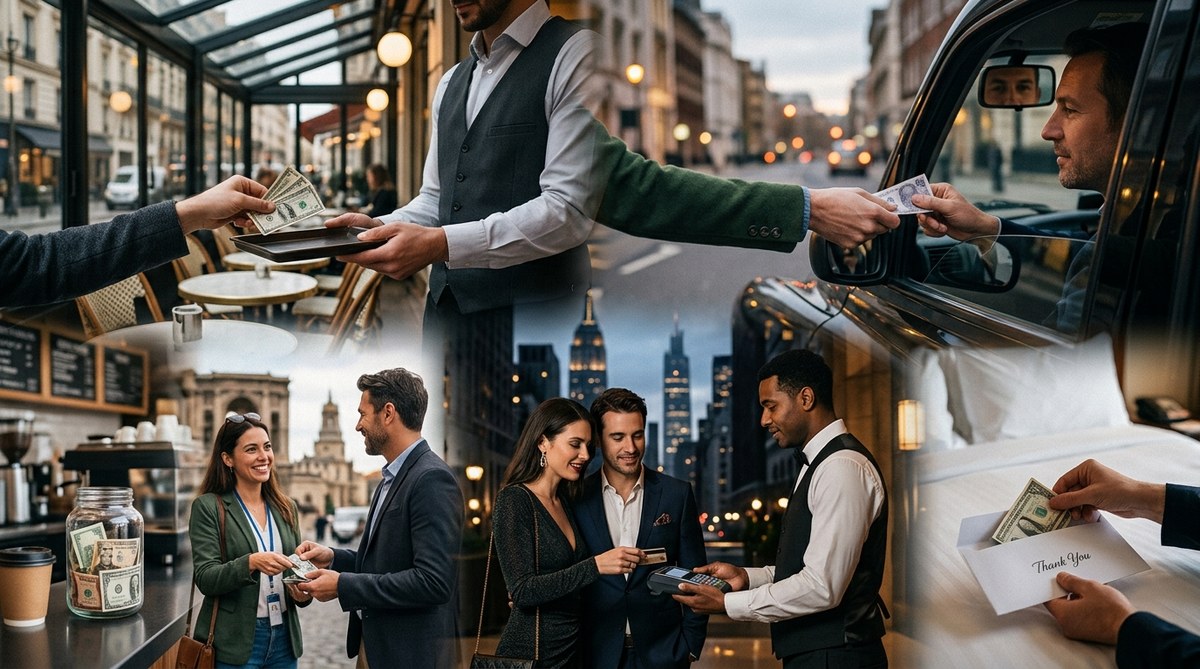
Tipping can feel like a high-stakes guessing game when you land in a new city. One wrong move and you risk looking cheap, clueless, or even offensive. Travelers from non-tipping cultures often struggle because the rules change not just by country but by neighborhood. The good news is that once you know the unwritten norms, you can move through any city with confidence and respect.
Tipping isn’t one-size-fits-all. In US cities, 20% is the baseline for sit-down meals. In Tokyo, handing cash directly to a server is insulting. European cities often include service, but not always. Always carry small bills for hotel staff and drivers. When in doubt, watch what locals do. The unwritten tipping rules major cities follow are about showing gratitude without creating awkwardness. Master these and you will never fumble the bill again.
The 10 Unwritten Tipping Rules Every Traveler Needs to Know
Here is a quick numbered overview of the most common mistakes tourists make with tipping in major destinations. After the list, we will break down each rule in detail.
- Treat 20% as the absolute floor in US cities, not the ceiling.
- Never leave cash on the table in Japan; use the designated tray.
- Always check the bill for a service charge in European restaurants before adding extra.
- Skip the tip at restaurants in China unless you are at a fine-dining hotel.
- Hand over cash tips for taxi drivers and porters in Latin American cities.
- Offer the concierge a folded bill when they secure a tough reservation.
- Do not tip taxi drivers in Tokyo or Seoul; they will refuse.
- Round up the fare or leave small change in Australia and New Zealand.
- Read the resort policy carefully before tipping at all-inclusive properties.
- Ask a local or hotel employee when you genuinely cannot figure it out.
Rule 1: In the United States, 20% Is the Baseline, Not a Bonus
New York, Los Angeles, Chicago. Cities across the US operate on a system where servers earn a tipped minimum wage that is far below the standard minimum. That means your tip is not a reward for good service. It is the core of their income. Leaving 15% because the meal was average signals you did not understand the system.
Here is what most tourists get wrong: they sit down at a nice restaurant in Manhattan, see the prices, and think a dollar or two is fine. In reality, the unwritten rule says 20% on the pretax amount for table service. Even for a quick breakfast at a diner, 15% is the minimum. Higher-end places and large groups may require 22% to 25%. If you see an automatic gratuity added, read the fine print. Some restaurants add 18% for parties of six or more, and they expect nothing extra on top.
For more tips on getting around US cities without overspending, check out our guide on how to find budget-friendly hotels in Europe’s most expensive cities (the same budgeting mindset applies to New York).
Rule 2: In Japan, Never Hand Cash Directly to a Server
Tokyo and Osaka are famous for excellent service that is included in the price. Leaving a tip on the table is seen as an insult, as if you are questioning the establishment’s ability to pay its staff. Most Japanese restaurants include a service charge already in your bill.
The unwritten rule here involves using the small tray that sits near the register or handing your payment over with both hands. If you want to show extra gratitude, a small gift or simply a polite bow works wonders. At a ryokan (traditional inn), tipping the housekeeper might be acceptable, but only in an envelope placed discreetly. Never leave coins. Coins are for machines, not for people.
If you are planning a trip to Tokyo, our 48-hour itinerary will help you navigate the city without common cultural missteps.
Rule 3: European Service Charges Can Be Tricky
Paris, Rome, London, and Madrid all have their own quirks. In France, a 15% service charge (service compris) is almost always included in the posted price. Locals do not leave extra change unless the service was outstanding. In Italy, the coperto (cover charge) covers bread and table service, so tipping is not required. But in tourist-heavy spots like Rome, many servers will expect a euro or two for good service.
The mistake tourists make is assuming that because they are in Europe, no tip is needed. That is not true in the UK, where a discretionary service charge of 12.5% is often added for groups of six or more. In Germany, rounding up the bill is standard. The unwritten rule for European cities: always look at the bill for the words “service included” or “service charge.” If you see it, you are done. If not, leaving 5% to 10% is polite but not mandatory.
For a deeper look at eating like a local in Rome, read our first-timer’s guide.
| City | Common Mistake | Correct Action |
|---|---|---|
| Paris | Leaving 15% on a bill that already includes service | Check for “service compris” and leave only small change if happy |
| Rome | Assuming no tip because of coperto | Add a euro or two for special service, but not required |
| London | Ignoring the “service charge” line | If not added, tip 10-12.5% for sit-down meals |
| Tokyo | Leaving cash on the table | Use the tray or envelope; never hand money directly |
Rule 4: In China, Tipping Is Almost Never Expected
Beijing, Shanghai, and Hong Kong (though Hong Kong has its own rules influenced by British customs) generally do not have a tipping culture. Handing extra money to a server can cause confusion or even be refused. The exception is in five-star hotels and Western luxury restaurants that cater to international tourists. In those places, a 10% service charge is often added.
The unwritten rule: do not tip at local noodle shops or street stalls. Do not tip taxi drivers. Do tip the bellhop at a high-end hotel in Shanghai one or two dollars. When in doubt, you can politely say “no thanks” if the server tries to give you change and you want them to keep it. That is the closest thing to a tip that feels natural.
Rule 5: Cash Is King in Latin American Cities
Mexico City, Buenos Aires, Lima, and Bogota all fall into a category where credit card tips often do not reach the workers. Many systems deduct a processing fee, or the employer keeps part of the gratuity. The unwritten rule is to tip in cash. Hand the bill to the server with the cash tip folded inside.
For restaurants, 10% to 15% is standard. For tour guides and drivers, a dollar or two at the end of the day is appreciated. In Mexico, leaving coins on the table is common, but paper money carries more weight. Avoid leaving tips on the credit card slip; the server may never see that money.
If you plan to use public transportation in Mexico City, our complete guide will help you move around like a local.
Rule 6: Concierges and Doormen Need a Discreet Handoff
In major US and European cities, the concierge at a luxury hotel can make or break your stay. Getting a last-minute reservation at a hot restaurant or securing sold-out theater tickets deserves a tip. The unwritten rule: offer a folded bill (5 to 20 dollars) when you ask for the favor, not after. That shows you understand the value of their connections.
Doormen who hail a cab or open doors generally expect a dollar or two per interaction in New York. In London, a pound per bag is standard for porters. The mistake tourists make is waiting until checkout to hand over everything at once. Instead, tip small amounts as service happens.
Rule 7: Taxi Drivers in Tokyo and Seoul Will Refuse
In both Japan and South Korea, taxi drivers pride themselves on giving exact change and not expecting tips. If you try to leave extra, they will likely chase you down to return it. That can create an awkward scene.
The unwritten rule is to simply round up the fare to the nearest convenient number if you must, but even that is unnecessary. In Seoul, some modern taxis have a card machine that asks if you want to add a tip. Most locals press “no tip.” If you want to show appreciation, a simple verbal thank you is enough.
Rule 8: Australia and New Zealand Prefer Rounding Up
Sydney, Melbourne, Auckland, and Wellington have a relaxed tipping culture. The minimum wage in both countries is high enough that service workers do not rely on tips. However, for exceptional service or in upscale restaurants, Australians will ask for the bill and say “keep the change” from a note.
The unwritten rule: round up the bill to the nearest 5 or 10 dollars. For example, if your meal costs $47, leave $50. That is considered polite but not mandatory. Never feel pressured to tip 20%. Locals rarely tip more than 10% for outstanding service, and many tip nothing at all.
For a budget-friendly trip down under, see our budget backpacker’s two-week Europe itinerary for inspiration on affordable planning.
Rule 9: All-Inclusive Resorts Have Subtle Rules
Cancun, Punta Cana, and other resort destinations operate on all-inclusive packages. Many tourists assume that everything is covered. While it is true that drinks and meals are included, the staff who serve you round the clock rely heavily on tips. The unwritten rule is to tip daily in cash, not just at the end of your stay.
Hand a dollar or two to the bartender with every round of drinks. Leave a few dollars on the table for your breakfast server. For housekeeping, an envelope with a note is more respectful than leaving cash on the pillow. The mistake tourists make is tipping only on the last day. By then, the staff who served you all week may have rotated shifts and never see your gratitude.
Rule 10: When Confused, Just Ask a Local
The final unwritten rule applies to every major city. If you are standing at a restaurant or hotel lobby and have no idea what the norm is, ask someone who works there. Hotel front desk staff deal with this question daily. They can tell you exactly what is expected.
Alternatively, watch the locals. If you see a local rounding up the bill, do the same. If you see them leaving nothing, follow their lead. The one thing tourists get wrong over and over is assuming that tipping works the same everywhere. It does not. Being observant and humble is the best strategy.
“The most common mistake international visitors make is applying their home country’s tipping logic to a new city. In Paris, you do not tip the way you do in New York. In Tokyo, you do not tip at all. Always assume you are wrong until you confirm.” – Elena Torres, travel etiquette consultant
Putting These Rules into Practice
Before your next trip, take five minutes to check the unwritten tipping rules major cities on our site. Print out a small cheat sheet or save a note on your phone. Have a mix of small bills in the local currency ready before you arrive. That way, you never fumble when the bill arrives or when a porter grabs your suitcase.
Tipping is ultimately about connection. It is a way to say “I see your effort and I appreciate it.” When you get it right, you leave a positive impression that lasts beyond your visit. So use these rules as a starting point, stay curious, and never feel embarrassed to ask. Your travels will be smoother, and the people you meet will feel respected. That is the real win.
For more city-specific travel advice, check out our guides to hidden neighborhoods in Paris and how to spend 5 days in Paris like a local. And if you are heading to Asia, our one week in Southeast Asia itinerary will help you plan without missing a beat.