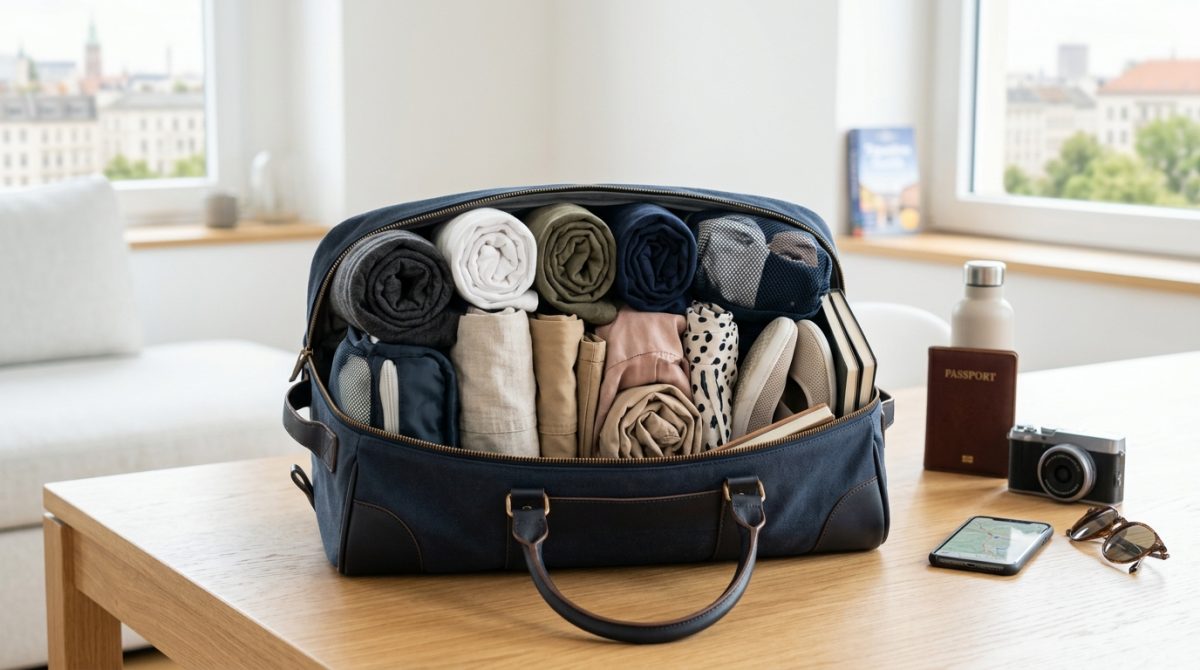
Flying basic economy doesn’t mean you need to sacrifice comfort or style for a week-long trip. With the right strategy, you can fit everything you need into a bag that slides under the seat in front of you. Airlines keep shrinking luggage allowances, but your wardrobe doesn’t have to shrink with it.
Packing a week’s worth of clothes in a personal item requires choosing versatile pieces, using compression techniques, and planning outfits around a cohesive color palette. Roll clothes tightly, wear your bulkiest items on the plane, and stick to 3-4 base colors. Most travelers can comfortably fit 5-7 tops, 2-3 bottoms, undergarments, and one pair of backup shoes using this method.
The Foundation: Choosing the Right Personal Item
Your bag choice matters more than you think. Most airlines allow personal items measuring around 18 x 14 x 8 inches, but always check your specific carrier’s requirements before you pack.
Backpacks work better than tote bags for this purpose. They distribute weight evenly and usually offer more cubic inches of actual usable space. Look for bags with multiple compartments to keep items organized and prevent everything from becoming a wrinkled mess.
Avoid bags with thick padding or rigid frames. These design features eat up precious interior space. A lightweight nylon or polyester bag gives you maximum room for clothes instead of structure.
Building Your Capsule Wardrobe
The secret to packing light isn’t about stuffing more into your bag. It’s about bringing less while still having plenty to wear.
Start by selecting a color palette of three to four colors that all work together. Black, white, and one accent color is a foolproof combination. Every piece should coordinate with at least two other items in your bag.
Here’s what a realistic week-long wardrobe looks like:
- 5 tops (mix of t-shirts, blouses, or button-downs)
- 2 pairs of pants or 1 pant and 1 skirt/shorts
- 1 dress that can be dressed up or down
- 7 pairs of underwear
- 4 pairs of socks
- 1 light jacket or cardigan
- 1 pair of shoes in your bag (wear your bulkier pair)
- 1 swimsuit if needed
Notice what’s missing? You don’t need a different outfit for every single day. Rewearing pants is completely normal. That jacket works with everything.
The Packing Process Step by Step
Follow this exact sequence to maximize space and minimize wrinkles.
- Lay out every item you plan to bring on your bed or floor
- Remove one-third of what you laid out (yes, really)
- Roll each clothing item tightly from bottom to top
- Place rolled underwear and socks inside shoes
- Pack heaviest items (shoes, toiletries) at the bottom of your bag
- Layer rolled clothes vertically so you can see each item
- Fill gaps with smaller items like chargers or accessories
- Place your jacket or cardigan on top as a cushion layer
Rolling beats folding every time. Rolled clothes take up less space, create fewer wrinkles, and let you see everything at a glance when you open your bag.
Compression Techniques That Actually Work
Packing cubes aren’t just organizational tools. They compress your clothes and create structure inside your bag.
Get one medium cube for tops and one for bottoms. Press down firmly as you zip them closed. This compression can save you 20-30% of your bag space.
For even more compression, try this method: roll your clothes, place them in a gallon-size plastic bag, and press out all the air before sealing. It works like a makeshift vacuum bag without needing any special equipment.
Wearing your bulkiest items on the plane is another form of compression. Put on your jacket, your thickest shoes, and your jeans for travel day. This frees up significant bag space for lighter items.
Common Mistakes and How to Avoid Them
| Mistake | Why It Fails | Better Approach |
|---|---|---|
| Packing “just in case” items | Takes space you actually need | Only pack what you’ll definitely use |
| Bringing full-size toiletries | Liquids are heavy and bulky | Use solid bars or buy items at destination |
| Folding instead of rolling | Creates wrinkles and wastes space | Roll everything except structured jackets |
| Packing a different shoe for every outfit | Shoes are space hogs | Bring one neutral pair that works with everything |
| Overpacking underwear | Seven pairs is enough for seven days | Do laundry in your hotel sink if needed |
The biggest mistake? Not doing a test pack before your trip. Pack your bag three days early, live out of it at home, and see what you actually use. You’ll probably find you can leave even more behind.
Toiletries and Extras Without the Bulk
Toiletries can sabotage your entire packing strategy if you’re not careful. A full shampoo bottle weighs more than two shirts.
Switch to solid versions of everything possible. Shampoo bars, conditioner bars, and solid facial cleansers take up minimal space and don’t count toward your liquid limit. They also won’t explode in your bag at altitude.
For items that must be liquid, use contact lens cases for face cream, foundation, or other products you need in tiny amounts. A week’s worth of moisturizer fits in one side of a lens case.
Skip the towel entirely. Hotels provide them, and if you’re staying in a hostel or Airbnb, a microfiber towel the size of a handkerchief dries you completely and takes up almost no room.
Pack your personal item as if you’re playing Tetris. Every gap is wasted space. Fill shoe interiors with socks, tuck charging cables into sunglasses cases, and slide thin items like tank tops into any remaining crevices. The goal is a bag so efficiently packed that nothing shifts during travel.
Laundry Strategy for Extended Trips
You don’t need 14 shirts for a two-week trip. You need seven shirts and a willingness to do laundry once.
Hand washing in a hotel sink takes about 10 minutes. Bring a small packet of laundry detergent or use the hotel shampoo in a pinch. Wring items out in a towel by rolling them up tightly, then hang everything to dry overnight.
Merino wool and synthetic fabrics dry much faster than cotton. A merino t-shirt can go from wet to wearable in four to six hours. Cotton might still be damp the next morning.
Many destinations have affordable laundromats or same-day laundry services. Spending $5-10 to wash your clothes midway through a trip beats paying $30-60 in checked bag fees.
What to Wear on the Plane
Your airplane outfit is prime real estate for your bulkiest items. This is where you stash everything that won’t fit in your personal item.
Wear your heaviest shoes, thickest jacket, and most structured pants. Layer a sweater over your shirt even if you’ll take it off after boarding. You can always stuff these items in the overhead bin once you’re seated.
Cargo pants or jackets with multiple pockets let you carry extra items without them counting toward your bag allowance. Passport, phone, snacks, and other small essentials can ride in your pockets instead of taking up bag space.
Adapting for Different Climates
Cold weather destinations require more strategy but are still manageable with a personal item.
Base layers are your best friend. One set of thermal underwear worn under your regular clothes provides warmth without bulk. You can wear the same jeans multiple days if you have fresh base layers underneath.
A packable down jacket compresses to the size of a water bottle but provides serious warmth. Get one that stuffs into its own pocket for easy packing.
For warm destinations, the challenge is different. Swimwear and beach clothes take up minimal space, but you might want more outfit variety. Stick to lightweight fabrics like linen and rayon that roll small and resist wrinkles.
The Two-Bag System
Some travelers use both their personal item and a small crossbody bag or purse. This technically counts as one personal item if the smaller bag fits inside the larger one during boarding.
Pack your main backpack with clothes, then carry a small crossbody with your laptop, documents, and valuables. Once you’re through the gate, you can wear the crossbody and carry the backpack. Flight attendants rarely enforce the one-bag rule if you’re already at your seat.
This system works especially well for business travelers who need a laptop and professional clothes. The crossbody holds your work items while the backpack carries your wardrobe.
Testing Your System Before You Travel
Don’t wait until the night before your flight to try this packing method. Give yourself time to adjust and refine.
Pack your bag a week early if possible. Unpack it. Repack it differently. See which rolling technique works best for your specific items. Figure out if your shoes actually fit or if you need to wear them instead.
Weigh your packed bag. Most personal items don’t have weight limits, but you’ll be carrying this bag through airports. Anything over 15 pounds gets uncomfortable fast.
Walk around your house with your packed bag for 20 minutes. Does it feel balanced? Are the straps comfortable? Can you access your essentials without unpacking everything? Make adjustments now, not at the airport.
Making It Work for You
Packing a week of clothes in a personal item isn’t about deprivation. It’s about freedom.
You’ll walk past the checked bag line, skip the baggage claim carousel, and head straight to your destination. You’ll never worry about lost luggage or pay another checked bag fee. Your travel days become faster, simpler, and less stressful.
The first time feels like a challenge. By your third trip, it becomes second nature. You’ll start to recognize which clothes work hard and which just take up space. Your packing gets faster and more efficient with every journey.
Start with a long weekend trip to practice. Once you see how little you actually need, that week-long vacation with just a personal item won’t seem impossible at all.