
You’re staring at two browser tabs. One shows a cozy apartment with a full kitchen for $120 per night. The other displays a hotel room at $150. The choice seems obvious, right? Not so fast. The sticker price rarely tells the whole story when comparing vacation rentals to hotels.
Vacation rentals often cost less than hotels for groups and longer stays, especially when you factor in cooking savings. However, cleaning fees, service charges, and minimum night requirements can flip the math. Hotels typically win for solo travelers and short trips, while rentals shine for families staying four nights or more. The real answer depends on your group size, trip length, and dining habits.
Breaking down the base price difference
Hotels advertise per-night rates that feel straightforward. You see $150, you pay roughly $150 plus taxes. Vacation rentals play a different game.
That $120 apartment comes with layers. A $75 cleaning fee. A $40 service charge. A $15 nightly resort fee in some destinations. Suddenly your three-night stay jumps from $360 to $525 before taxes.
The math shifts dramatically with group size. A hotel room sleeping two costs the same whether one or two people book it. Add a third person and you’re looking at a second room or suite upgrade. A vacation rental sleeping six costs the same for two guests or six.
Here’s where the numbers get interesting. A family of four booking two hotel rooms at $150 each spends $300 per night. That same family in a two-bedroom rental at $200 per night saves $100 daily, even before the cleaning fee calculation.
Length of stay matters just as much. Those fixed vacation rental fees spread thinner across more nights.
| Stay Length | Hotel (2 rooms) | Vacation Rental | Winner |
|---|---|---|---|
| 2 nights | $600 | $565 (with fees) | Rental (barely) |
| 4 nights | $1,200 | $955 | Rental |
| 7 nights | $2,100 | $1,565 | Rental |
| 1 night | $300 | $395 | Hotel |
The cleaning fee stings hardest on short trips. Paying $100 to clean an apartment you used for one night feels absurd. Spread that same fee across ten nights and it barely registers.
Hidden costs that swing the balance
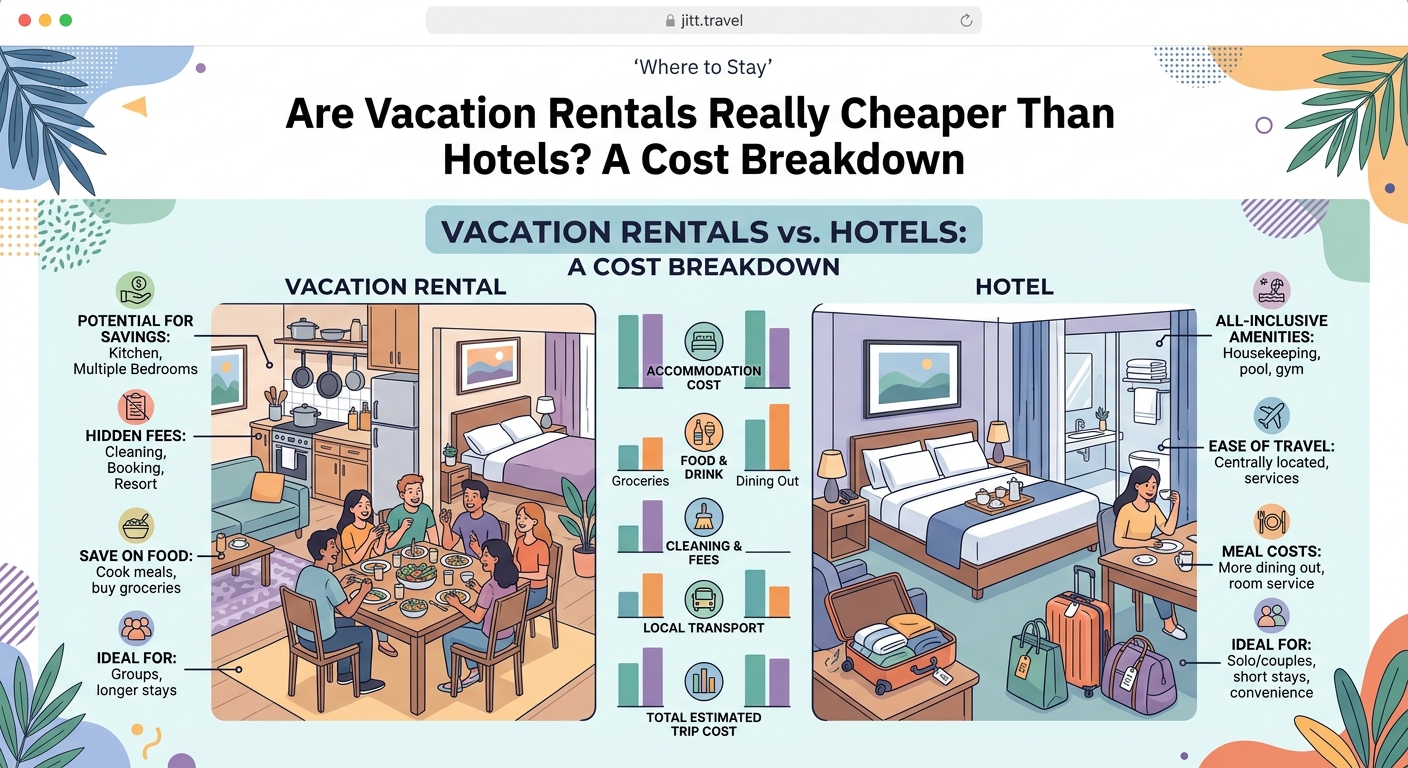
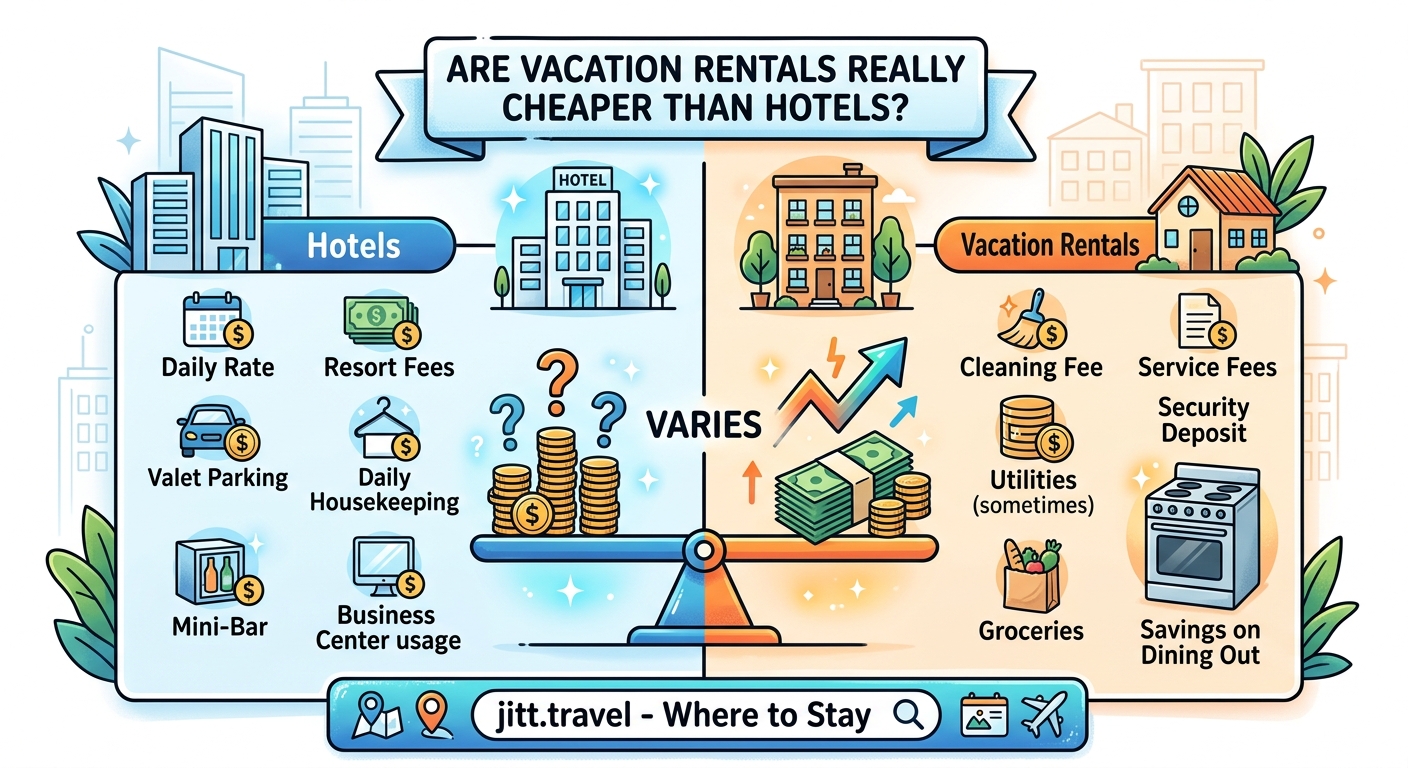
Service fees deserve their own spotlight. Booking platforms charge 10% to 15% on top of the rental price. A $1,000 week-long rental becomes $1,150 before you’ve packed a bag.
Hotels bundle differently. Resort fees, parking charges, and WiFi costs (yes, some still charge) add up. A $150 room becomes $185 with a $25 resort fee and $10 parking. Do that math over a week and you’ve added $245.
Security deposits create another wrinkle. Vacation rentals often hold $250 to $500 on your card. You get it back, but it ties up funds during your trip. Hotels place smaller incidental holds, usually $50 to $100 per night.
Minimum night requirements hit weekend travelers hard. That beach condo requires a seven-night stay in summer. You wanted four nights. Now you’re paying for three empty nights or booking a pricier hotel instead.
The biggest mistake travelers make is comparing nightly rates without calculating total trip cost. Always run the full numbers including every fee, then divide by actual nights stayed. That’s your true nightly rate.
The meal equation changes everything
This factor flips budgets more than any other. Hotels mean eating out for every meal. Vacation rentals give you a kitchen.
A family of four spending $15 per person on breakfast, $20 on lunch, and $35 on dinner racks up $280 daily in restaurant bills. Over a week, that’s $1,960 just on food.
Cut that in half by cooking breakfasts and some dinners. You’ve saved nearly $1,000. Suddenly that vacation rental doesn’t just compete with the hotel, it wins by a landslide.
The savings multiply with kids. Restaurant meals with children under ten still cost plenty. Grocery shopping lets you buy exactly what they’ll actually eat instead of paying $12 for chicken fingers they’ll ignore.
Coffee alone adds up. Hotel coffee makers produce sad results. The lobby Starbucks charges $6 per latte. Two coffee drinkers over seven days spend $84. A vacation rental with a decent coffee maker and $20 in supplies saves $64.
Consider these daily food cost scenarios:
- Full restaurant dining: $280 for a family of four
- Breakfast and dinner at rental, lunch out: $140
- Most meals at rental, two dinners out: $100
- Hotel with free breakfast, other meals out: $200
The kitchen advantage extends beyond cost. Dietary restrictions become manageable. Gluten-free, vegan, or allergy-conscious eating gets expensive and stressful at restaurants. Your own kitchen solves both problems.
When hotels actually cost less
Solo business travelers rarely benefit from vacation rentals. You don’t need three bedrooms. You won’t cook. Hotel loyalty points, free breakfast, and included amenities make more sense.
One-night stays almost always favor hotels. Even a modest $50 cleaning fee makes rentals uncompetitive. Add the hassle of check-in procedures and key pickup, and hotels win on convenience too.
City center locations tip toward hotels. Vacation rentals in downtown areas often cost more than comparable hotels because of real estate values. A Manhattan apartment runs $400 nightly while a hotel three blocks away charges $250.
Last-minute bookings favor hotels. Vacation rental owners rarely discount unsold nights the way hotels do. Check hotel apps two days before arrival and you’ll find deals. Rental platforms don’t work that way.
Business amenities matter for work trips. Hotels offer meeting rooms, business centers, and reliable high-speed internet. Vacation rentals promise WiFi but speeds vary wildly. That video conference call might not happen smoothly.
Calculating your actual cost per person per night
Stop looking at nightly rates. Start calculating total trip cost divided by people and nights.
Here’s the formula that matters:
- Add base rental or hotel cost for all nights
- Include every fee (cleaning, service, resort, parking)
- Add estimated food costs based on your dining plan
- Divide by number of people in your group
- Divide again by number of nights
A $1,200 hotel stay with $400 in fees and $1,600 in meals totals $3,200. For four people over five nights, that’s $160 per person per night.
A $900 rental with $200 in fees and $800 in groceries totals $1,900. Same four people, same five nights equals $95 per person per night.
The $65 per person per night difference adds up to $1,300 in savings. That pays for activities, excursions, or a nicer flight home.
Location costs beyond the room rate
Transportation expenses shift based on accommodation type. Vacation rentals in residential neighborhoods often require rental cars. Daily rates plus parking and gas add $50 to $80 per day.
Hotels in walkable areas eliminate car needs. You’ll spend more on the room but save $350 to $560 over a week by skipping the rental car.
Parking fees deserve scrutiny. Urban hotels charge $30 to $60 for overnight parking. Vacation rentals might include free spots or street parking that requires permit juggling and meter feeding.
Tourist area vacation rentals sometimes sit farther from attractions than hotels. You’re saving $40 nightly on accommodation but spending $25 daily on rideshares. Over six nights, the hotel becomes cheaper.
Beach access matters at coastal destinations. Hotels on the sand include chairs and umbrellas. Vacation rentals three blocks back save money upfront but beach equipment rentals cost $40 daily. Six days equals $240, erasing your accommodation savings.
Group size sweet spots
Solo travelers should book hotels 95% of the time. The only exception is month-long stays where even with fees, rentals become economical.
Couples find mixed results. Short city trips favor hotels. Week-long beach vacations tilt toward rentals if you’ll cook some meals.
Families of four or more hit the vacation rental sweet spot. You need space anyway. Two hotel rooms cost more than most rentals. The kitchen saves enough on food to justify any fee structure.
Large groups of six to twelve people find no competition. Hotels require three to six rooms. Vacation rentals offer whole houses at a fraction of the cost. A $400 per night house beats $900 in hotel rooms every time.
Multi-generational trips benefit enormously from rentals. Grandparents get their own space. Kids have room to play. Everyone gathers in a real living room instead of cramped hotel quarters. The cost savings just sweeten an already better experience.
Amenities that actually save money
Laundry facilities cut packing needs and baggage fees. A washer and dryer let you pack half the clothes. Checked bag fees run $30 to $60 each way per person. A family of four saves $240 to $480 by packing lighter.
Full kitchens provide the biggest financial impact, as covered earlier. But even a kitchenette with a microwave, mini-fridge, and coffee maker enables meaningful savings.
Private pools eliminate daily water park fees. Theme park hotels charge $80 per person for water park access. A rental with a pool saves $320 daily for a family of four.
Parking spots save urban travelers $30 to $60 nightly. Over a week, that’s $210 to $420 back in your budget.
Game rooms and entertainment spaces reduce activity costs. Kids entertained at the rental mean fewer expensive outings. Board games, pool tables, and video game systems provide free evening entertainment.
The true cost comparison for real trips
Let’s run actual scenarios with realistic numbers.
Scenario 1: Weekend city break, two people, two nights
Hotel option: $180 per night, $25 resort fee, $15 parking, free breakfast. Lunch and dinner out both days. Total: $590 (room and fees) plus $320 (meals) equals $910.
Rental option: $140 per night, $95 cleaning fee, $45 service fee. No breakfast, all meals out. Total: $560 (rental and fees) plus $400 (meals) equals $960.
Winner: Hotel by $50
Scenario 2: Beach week, family of four, seven nights
Hotel option: Two rooms at $160 each, $30 resort fee per room, $20 parking. Continental breakfast included, other meals out. Total: $2,940 (rooms and fees) plus $2,800 (meals) equals $5,740.
Rental option: Three-bedroom house at $275 per night, $150 cleaning fee, $250 service fee. Cook five breakfasts and four dinners, eat out otherwise. Total: $2,325 (rental and fees) plus $1,400 (meals and groceries) equals $3,725.
Winner: Rental by $2,015
Scenario 3: Business trip, one person, four nights
Hotel option: $140 per night, points earned, free breakfast, free WiFi. Lunch and dinner out. Total: $560 (room) plus $400 (meals) equals $960.
Rental option: $110 per night, $80 cleaning fee, $65 service fee. All meals out, no loyalty benefits. Total: $585 (rental and fees) plus $480 (meals) equals $1,065.
Winner: Hotel by $105
Smart booking strategies for either option
Book vacation rentals directly with owners when possible. You’ll skip the 12% to 15% platform service fee. A $1,000 rental saves $120 to $150.
Hotels reward direct booking too. Call the property after finding online rates. Ask if they’ll match and throw in free breakfast or parking. Many will.
Consider shoulder season timing. Vacation rental cleaning fees stay constant but nightly rates drop 30% to 50%. Hotels discount too, but the rental savings become more dramatic.
Negotiate minimum night requirements. Owners with empty calendars often waive seven-night minimums for five or six nights, especially close to check-in dates.
Read fee structures carefully. Some rentals charge per-person fees above a certain occupancy. Your six-person group might trigger $15 per person per night charges for guests five and six. That’s $210 over a week.
Making the math work for your trip
Start by honestly assessing your dining habits. If you realistically won’t cook, don’t pay for a kitchen you’ll ignore. Hotels make more sense.
Count your group accurately. Two couples should consider both options. Four adults might split costs better with two hotel rooms and more flexibility.
Factor in your time value. Vacation rental check-ins take longer. Key pickup, property walkthroughs, and checkout cleaning requirements eat vacation hours. Hotels hand you a key card in three minutes.
Consider the experience you want. Rentals feel like living somewhere. Hotels feel like visiting. Neither is better, but they’re different. Sometimes the intangible value matters more than $200 in savings.
Calculate the break-even point. At what trip length does the rental become cheaper? For most families, it’s around three to four nights. Shorter than that, hotels win. Longer, and rentals pull ahead.
Your budget deserves better than guesswork
The answer to whether vacation rentals cost less than hotels isn’t yes or no. It’s “it depends on your specific trip.”
Run the real numbers for your actual travel party and length of stay. Include every fee. Estimate food costs honestly. Factor in transportation and parking. Only then will you know which option stretches your budget further.
The best choice saves you money while delivering the experience you want. Sometimes that’s a hotel with room service and daily housekeeping. Sometimes it’s a rental where you make pancakes in pajamas while kids play in the yard.
Do the math, then book with confidence. Your wallet will thank you either way.