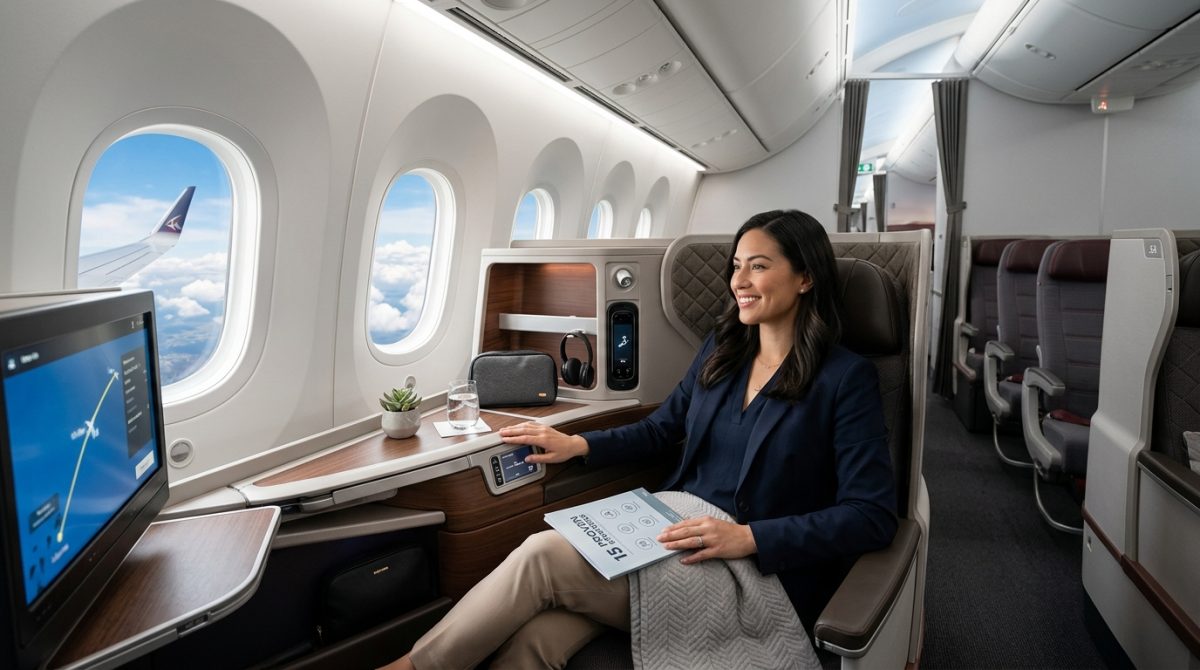
Flying business class doesn’t have to drain your savings account. Thousands of travelers sit in lie-flat seats, sip champagne, and skip airport crowds while paying a fraction of the sticker price. The difference between them and everyone else? They know which strategies actually work.
Flying business class affordably requires combining multiple strategies: earning and redeeming airline miles, booking during sales, bidding for upgrades, choosing less popular routes, and staying flexible with dates. Most travelers pay 50-90% less than retail prices by using credit card points, mistake fares, positioning flights, and airline loyalty programs strategically. Success comes from patience, planning, and knowing exactly when and where to book.
Master the Art of Airline Miles and Points
Credit card sign-up bonuses represent the fastest path to business class seats. A single card can deliver 60,000 to 100,000 points after meeting minimum spending requirements.
Those points translate directly into premium cabin flights. American Airlines AAdvantage miles can book business class to Europe for 57,500 points one-way. Chase Ultimate Rewards points transfer to United, allowing you to fly to Asia in Polaris business for 80,000 points.
The math works beautifully. Spending $4,000 in three months on groceries, gas, and bills you’d buy anyway nets you enough points for a transatlantic business class ticket worth $3,000 or more.
Here’s how to maximize your earning:
- Open cards strategically during bonus promotions (75,000+ points)
- Meet minimum spend naturally through regular expenses
- Transfer points to airline partners during transfer bonuses
- Combine points from multiple cards in the same family
- Use shopping portals for bonus miles on everyday purchases
Many travelers maintain 2-3 cards simultaneously, rotating spending to hit bonuses throughout the year. This approach generates 200,000+ points annually without changing spending habits.
Book Award Flights During Sweet Spots
Airlines price award seats dynamically, but patterns exist. Certain routes, dates, and booking windows offer exceptional value.
Flying from the US to the Middle East via Qatar Airways Qsuite costs 70,000 American miles in business class. That same seat sells for $5,000+ in cash. The value per point exceeds 7 cents, far above the typical 1.5-2 cent benchmark.
Partner airlines create additional opportunities. Japan Airlines business class from the US to Tokyo costs just 60,000 Alaska miles. Turkish Airlines charges 52,500 miles for US to Europe flights in their excellent business product.
Timing matters enormously. Book 11-12 months out for the best availability on popular routes. Airlines release award seats in waves, with another batch appearing 2-3 weeks before departure when they assess remaining inventory.
“The difference between finding award availability and striking out often comes down to flexible dates. Search plus or minus three days from your ideal departure, and suddenly seats appear that looked impossible.” – Award travel expert
Bid Your Way Into Premium Cabins
Most major airlines now offer upgrade bidding systems. You submit an offer to upgrade from economy, and the airline accepts or declines based on demand.
United’s PlusPoints, Delta’s Upgrade Certificates, and third-party systems like Plusgrade make this possible. The winning bid often costs 30-50% of the fare difference between cabins.
A $600 economy ticket might upgrade to business class for an additional $400-800, while buying business outright would cost $2,500. You save $1,000+ by bidding strategically.
Best practices for upgrade bids:
- Research typical winning bid amounts on FlyerTalk forums
- Submit bids 5-7 days before departure when airlines assess loads
- Bid higher on routes with larger business class cabins
- Target off-peak travel days (Tuesday, Wednesday, Saturday)
- Increase bids slightly above round numbers ($510 instead of $500)
Airlines rarely share acceptance rates, but experienced travelers report 40-60% success rates when bidding intelligently on appropriate routes.
Hunt for Mistake Fares and Flash Sales
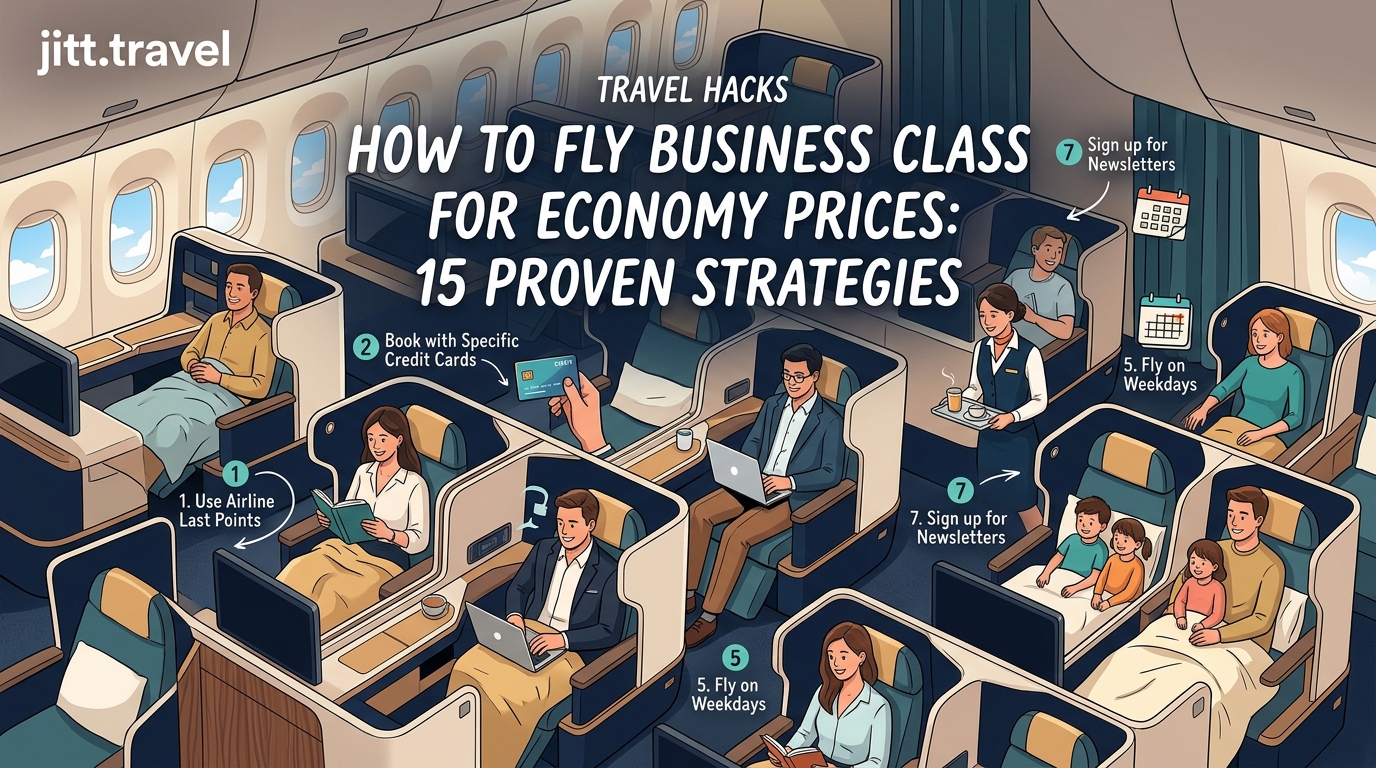
Airlines occasionally publish incorrect fares due to currency conversion errors, missing fuel surcharges, or system glitches. These “mistake fares” offer business class at economy prices.
A famous 2019 error priced Cathay Pacific business class from Vietnam to North America at $675 roundtrip. Normal cost: $4,000+. The airline honored most tickets.
Secret Flying, Going, and FlyerTalk’s Mileage Run forum track these deals in real time. Act within hours, as airlines correct mistakes fast.
Flash sales happen more predictably. Airlines dump unsold premium inventory 2-4 weeks before departure. Sign up for:
- Airline email newsletters (actual deals, not spam)
- Fare alert services for specific routes
- Credit card travel portals that sometimes price match
- Airline social media for 24-hour flash promotions
Sales typically run Thursday through Monday. Business class to Europe drops to $1,200-1,800 roundtrip during shoulder seasons, compared to $4,000+ normally.
Choose Strategic Routes and Positioning Flights
Geography determines pricing. Flying from New York to London in business class costs less than flying from Kansas City to London, even though the latter includes a domestic connection.
The solution? Positioning flights. Book a separate economy ticket to a major hub, then catch your discounted business class flight from there.
Consider this comparison:
| Route | Typical Business Class Price | Strategy | Actual Cost |
|---|---|---|---|
| Austin to Paris direct | $4,200 | Book separately | $180 + $1,800 |
| Dallas to Paris | $1,800 | Use major hub | $1,800 total |
| Small city to Asia | $6,500 | Position to LAX | $250 + $2,200 |
Secondary airports also offer savings. Flying into Oakland instead of San Francisco, or Newark instead of JFK, sometimes cuts business class fares by 30%.
Less popular routes price lower too. Business class to secondary European cities (Porto, Krakow, Bucharest) costs significantly less than London or Paris, even on the same airlines.
Time Your Bookings Perfectly
Airlines adjust prices constantly based on demand algorithms. Knowing when to book saves thousands.
For international business class, the sweet spot sits 3-6 months before departure. Too early and promotional fares haven’t appeared. Too late and inventory disappears.
Domestic upgrades work differently. Book economy far in advance for the lowest fare, then upgrade using miles or bid systems closer to departure.
Day of week matters significantly:
- Tuesday and Wednesday departures cost 15-25% less
- Sunday evening flights command premium pricing
- Red-eye flights often price lower in business class
- Holidays and school breaks spike by 40-60%
Seasonality creates huge variations. Business class to Europe in November costs half the June price. Asia sees similar patterns outside of cherry blossom season and major holidays.
Set fare alerts three months out. When prices drop 20% below average, book immediately. Prices rarely decrease further for premium cabins.
Leverage Airline Status and Loyalty Programs
Elite status unlocks upgrade opportunities unavailable to regular travelers. Airlines reward loyalty with complimentary and discounted upgrades.
Earning status requires flying 25,000-75,000 miles annually on a single airline or partners. The payoff includes:
- Complimentary upgrades on domestic routes
- Discounted upgrade costs using miles
- Priority upgrade waitlists
- Bonus miles accelerating future redemptions
- Waived award booking fees
Status matching and challenges provide shortcuts. Fly one paid business class ticket, then request status based on that booking. Many airlines grant 90-day trial status to prove you’ll continue flying with them.
Credit cards offer another path. Premium cards like the Platinum Card provide automatic status with certain hotel programs, and some airlines extend benefits to cardholders.
Consolidate flying on one alliance (Star Alliance, Oneworld, or SkyTeam) to earn status faster. A United status member gets benefits on Lufthansa, Singapore Airlines, and 25 other partners.
Book Directly With Foreign Airline Websites
Pricing varies dramatically based on where you book. The same business class seat costs different amounts on different websites.
Airlines price based on point of sale and currency. A ticket from New York to Mumbai might cost $3,200 on United.com but only $2,400 when booked through Air India’s website for the exact same United-operated flight.
Try booking on:
- The foreign carrier’s website in local currency
- Partner airline websites for codeshare flights
- Different country versions (.co.uk, .com.au, .de)
- Travel agents specializing in international bookings
Use a VPN to access regional pricing, though airlines increasingly detect and block this practice. Clearing cookies between searches prevents dynamic pricing based on browsing history.
Always compare the same flight across multiple booking platforms. Price differences of $500-1,500 appear regularly for identical seats.
Consider Premium Economy as a Stepping Stone
Premium economy costs 50-100% more than economy but 60-70% less than business class. For budget-conscious travelers, it offers a middle ground with significant comfort improvements.
The cabin features more legroom, wider seats, better meals, and priority boarding. On 10+ hour flights, these upgrades matter tremendously.
More importantly, premium economy tickets upgrade to business class more easily. Airlines prioritize premium economy passengers for complimentary upgrades when business class has empty seats.
Some airlines price premium economy remarkably low during sales. Singapore Airlines, Lufthansa, and Air New Zealand frequently offer premium economy at just $200-400 above economy fares.
Calculate the upgrade cost from premium economy to business using miles or bids. Sometimes paying $1,000 for premium economy plus 30,000 miles to upgrade beats paying $3,000 for business class outright.
Use Stopover Strategies for Multiple Destinations
Many airlines allow free or cheap stopovers on award tickets. Book one ticket in business class that includes 2-3 cities for barely more miles than a direct flight.
Icelandair permits free stopovers in Reykjavik for up to seven days. TAP Portugal allows stops in Lisbon. Turkish Airlines encourages Istanbul layovers with free hotel stays for long connections.
This strategy works brilliantly with miles. An American Airlines award from the US to Europe costs 57,500 miles one-way in business. Adding a stopover in London before continuing to Rome costs the same 57,500 miles but delivers two destinations.
Search multi-city awards on airline websites. Many hide this option, requiring phone bookings. The extra $25-50 phone fee pays for itself when you score two business class flights for one award price.
Plan stopovers in cities you actually want to visit. A 23-hour layover in Doha becomes a free bonus trip rather than wasted time.
Watch for Credit Card Portal Bonuses
Bank travel portals occasionally offer outsized value for business class bookings. Chase Ultimate Rewards, American Express Membership Rewards, and Citi ThankYou points sometimes provide better redemption rates than transferring to airlines.
Portal bonuses stack with card earning rates. A 5x travel card used through the portal earns points on the purchase, while redeeming existing points at enhanced values.
Chase Sapphire Reserve cardholders redeem points at 1.5 cents each through the portal. A $2,000 business class ticket costs 133,333 points instead of the 200,000 points the same flight might require through airline partners.
Amex occasionally offers 35% point rebates on business class bookings through their portal. Book a $3,000 ticket for 300,000 points, receive 105,000 back, netting a 2.3 cent per point value.
Check portal pricing before transferring points to airlines. Once transferred, points can’t move back. Portal bookings also earn airline miles, elite qualifying credits, and provide better refund policies than award tickets.
Target Airline Sales and Promotions
Airlines run predictable sale cycles. Presidents Day, Memorial Day, Labor Day, and Black Friday consistently feature business class promotions.
Winter sales target summer Europe travel. Spring promotions discount fall Asia trips. Airlines want to fill seats 6-9 months out when booking patterns are most predictable.
Subscribe to airline newsletters, but filter them into a dedicated folder. Most emails contain no deals, but the 2-3 genuine sales per year deliver extraordinary value.
Transfer bonuses deserve special attention. Chase, Amex, and Citi periodically offer 20-30% bonuses when moving points to airline partners. A 30% bonus means 70,000 points become 91,000, potentially covering the difference between economy and business class awards.
Airline shopping portals multiply earnings. Buying gift cards through airline portals during bonus promotions can generate thousands of extra miles. A $500 purchase might earn 2,500 bonus miles on top of credit card rewards.
Book Separate One-Way Tickets
Roundtrip business class tickets often cost more than two one-way tickets on different airlines. Airlines price one-ways dynamically, creating arbitrage opportunities.
Fly to Europe on Norwegian’s affordable premium cabin, return on a discounted Lufthansa business class fare. Mix and match airlines based on whoever’s running sales for each direction.
This approach requires more research but saves substantially. A roundtrip from Los Angeles to Tokyo might cost $4,500 on one airline, while mixing United outbound ($1,800) and ANA return ($1,900) totals just $3,700.
Award tickets work similarly. Use American miles for the outbound flight, United miles for return. Different programs price the same routes differently based on their award charts and partner agreements.
One-way flexibility also helps when plans change. Modify one direction without paying change fees on both flights. During uncertain times, this flexibility carries real value.
Join Airline Newsletters and Loyalty Programs Early
Airlines reward members who’ve been with them longer. Some unpublished deals go only to established accounts.
Creating accounts costs nothing. Join every major airline’s program, even if you rarely fly them. Accounts stay active with minimal activity, and opportunities appear unexpectedly.
Promotional bonuses target specific member segments. New members get sign-up bonuses. Inactive members receive reactivation offers. Long-term members get anniversary bonuses.
Some airlines offer status matches or challenges only to members who’ve held accounts for 90+ days. Opening accounts now prepares you for future opportunities.
Link all accounts to a single email address. Use filters to organize promotions by airline. Check monthly for targeted offers that might not appear publicly.
Your Path to Affordable Business Class Flying
Flying business class affordably isn’t about luck. It’s about knowing which levers to pull and when to pull them.
Start with one or two strategies that match your situation. Earn credit card points if you have good credit and regular expenses. Hunt mistake fares if you’re flexible. Build airline status if you already fly frequently for work.
Layer strategies as you gain experience. Combine points earning with strategic booking windows. Stack status benefits with upgrade bidding. Mix positioning flights with award redemptions.
The travelers sipping champagne at 35,000 feet aren’t necessarily wealthier. They simply learned the system and use it consistently. Your first business class flight using these methods won’t be your last.